
Nairobi, June 10 (Xinhua) — Special Report | China and Africa Jointly Write a New Chapter in African Agricultural Modernization
In recent years, under the framework of the Forum on China Africa Cooperation and the “the Belt and Road” initiative, China has effectively improved Africa’s agricultural production efficiency and sustainable development capacity and promoted Africa’s agricultural modernization by helping Africa’s infrastructure construction, production equipment upgrading and industrial chain extension.
Looking ahead to the future, China will fully implement the “China’s Assistance to African Agricultural Modernization Plan”, focus on development shortcomings, innovate cooperation paths, and make the dividends of agricultural modernization benefit more African people.
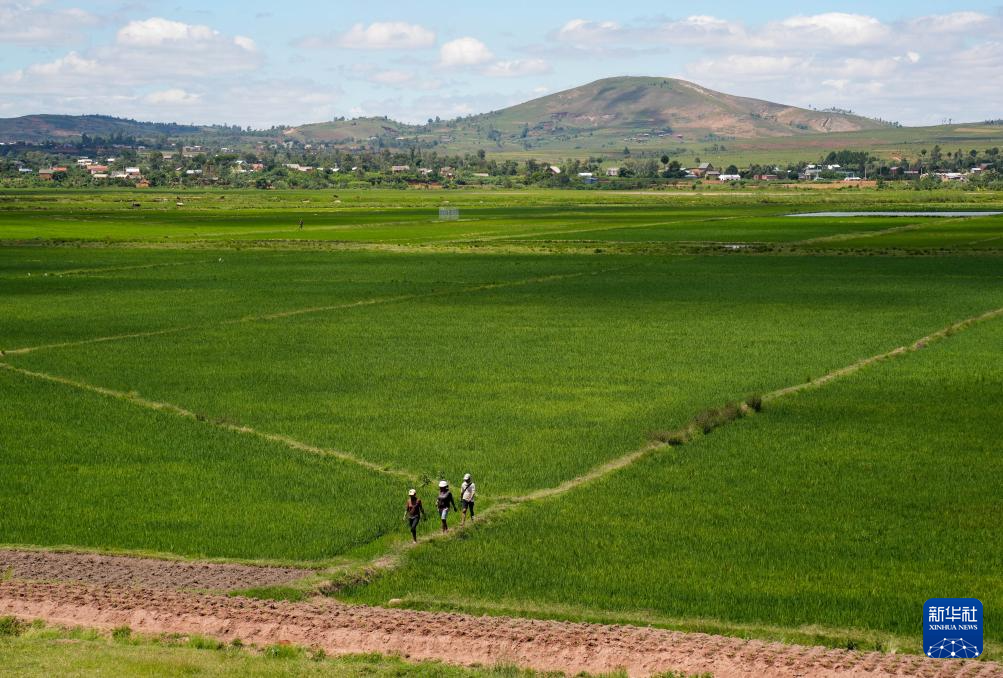 On March 26th, farmers walked in the demonstration fields of China’s high-yield hybrid rice demonstration base in Mahizi town, Madagascar. Photo by Xinhua News Agency reporter Li Yahui
New technologies bring new hope
In March, during the rainy season in Madagascar, the town of Masizi, located about 35 kilometers from the capital city of Antananarivo, is lush with greenery at the Chinese hybrid rice high-yield demonstration base. Agricultural expert Hu Yuefang is inspecting the growth of rice seedlings with local rice farmers.
Rice is the main food crop in Madagascar, accounting for more than half of the agricultural planting area. However, due to limitations in seed quality and planting techniques, the yield has long been difficult to meet domestic demand. In order to help Madagascar achieve self-sufficiency in food, the Chinese Aid to Madagascar Hybrid Rice Demonstration Center project was officially launched in 2007. Several Chinese agricultural experts went deep into the fields of Madagascar to carry out scientific research, demonstration, promotion and other work.
After years of effort, Chinese agricultural experts have adapted to local conditions and successfully bred five high-quality hybrid rice varieties, with an average yield of 7.5 tons per hectare, which is two to three times that of local conventional varieties. At present, the cumulative planting area of Chinese hybrid rice in Madagascar is about 90000 hectares, making the country the country with the widest planting area of hybrid rice in Africa.
In addition to promoting high-quality seeds, Chinese agricultural experts pay more attention to imparting “good practices”. In addition to teaching hands-on in demonstration fields, they have also trained batches of agricultural technical backbone for the local area through systematic teaching.
Three years ago, farmer Fermosoa Lakatongdrazara switched to planting hybrid rice, which significantly improved the living conditions of his family of four. He said, “Hybrid rice has brought us new hope. In the past, we couldn’t even guarantee food and clothing, but now we can still have surplus grain to sell and save money to expand planting
Chinese hybrid rice technology not only helps us achieve self-sufficiency in rice production, but also significantly improves the country’s food security level, “said Michel Anondraka, Director General of Agriculture and Livestock at the Ministry of Agriculture and Livestock of Madagascar.
Nowadays, Chinese hybrid rice has been promoted and planted in more than 20 African countries, becoming a vivid portrayal of China’s agricultural technology taking root and blooming in Africa. In recent years, with the continuous deepening of agricultural cooperation between China and Africa, a number of agricultural aid projects have been vigorously promoted in various parts of Africa.
In Morogoro Province, Tanzania, China Agricultural University has carried out the “small technology, Dafengshou (Salad of assorted fresh vegetables)” project with corn yield increase as the core since 2011, passing on the “Chinese experience” of corn dense planting and yield increase to farmers. The project has been promoted to more than ten villages and over a thousand households so far, and the average corn production of participants has doubled.
In Rwanda, Chinese mushroom grass technology is known locally as the “wealth grass” and “happiness grass”. More than 4000 farmers have achieved industrial transformation through mushroom grass technology, driving employment for over 30000 people. At present, this “Chinese grass” has taken root in more than 100 countries around the world and established demonstration bases in 17 countries.
According to the first three-year plan of the 2035 Vision for China Africa Cooperation, China has dispatched over 500 agricultural experts to Africa and trained nearly 9000 people. By the end of 2023, China has established 24 agricultural technology demonstration centers in Africa, promoted over 300 advanced agricultural technologies, and increased local crop yields by an average of 30% to 60%, benefiting more than one million African small farmers.
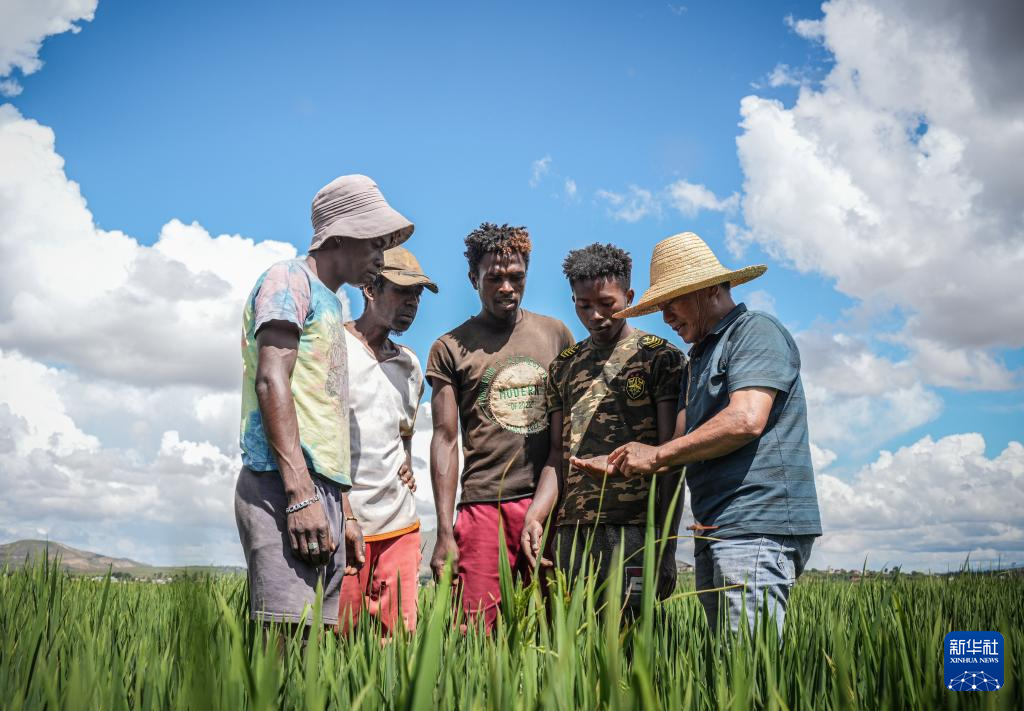 On March 25th, in Mahizi town, Madagascar, Chinese agricultural expert Hu Yuefang (first from the right) introduced the growth of rice to local rice farmers. Photo by Xinhua News Agency reporter Li Yahui
The ‘China Plan’ empowers agricultural production
In Siaya County, western Kenya, farmer Peter Onyango introduced clear river water for the first time through irrigation channels into newly excavated fields. The irrigation canal he used for water intake belongs to the irrigation and flood control project in the lower reaches of the N’Zoya River in Kenya, which is currently the largest irrigation facility in Kenya and is constructed by China Electric Power Construction Municipal Construction Group Co., Ltd. The main body of the project will be completed in April 2024, achieving water supply and bringing vitality to the arid and barren land along the route.
Agriculture is the backbone of Kenya’s economy, accounting for 70% of the population. However, only about 4% of the country’s arable land has irrigation facilities, and agricultural production is highly dependent on rainfall. With the increase of extreme weather in recent years, agricultural production in Kenya has been affected. In this context, the irrigation and flood control project for the lower reaches of the Enzoya River was born, including the construction of 111 kilometers of irrigation channels, 71 kilometers of drainage channels, 736 kilometers of field irrigation channels, and 37 kilometers of flood control embankments at all levels.
Kenyan President Ruto stated during his inspection of the project this year that it will help alleviate Kenya’s food shortage and make a significant contribution to the country’s economic transformation.
Edward Muya, an agricultural irrigation expert at the Kenya National Irrigation Authority, stated that Chinese enterprises have utilized modern technology, innovative models, and scientific management in project construction. This project can serve as a demonstration to promote the transformation of Kenya and even the entire Africa from rain dependent agriculture to sustainable irrigated agriculture.
In KwaZulu Natal Province, South Africa, Fangtingsil Manor has been equipped with drones produced by China Jifei Technology Co., Ltd., which can accurately spray pesticides at a height of 3 meters above the plantation’s sugarcane fields. This 2250 hectare farm has long been plagued by sugarcane stem borer damage, with traditional manual pesticide spraying being inefficient and causing significant losses. Chinese drones have completely revolutionized our production methods, “said the agricultural manager of the estate, Dion Bouguer
The advantage of drone operation lies in its high efficiency. Agricultural service contractor John Prinzlu said that manually spraying pesticides on 40 hectares of sugarcane forests requires 30 to 40 people to work for a whole day, while using drones only requires three people to complete the operation. In flat areas, the daily operation volume of a single drone can reach up to 170 hectares.
Since entering the South African market in 2020, Jifei drones have served over 1 million acres of farmland. Nowadays, this smart production equipment has expanded from South Africa to wider African territories such as Mozambique, Ethiopia, and Ghana.
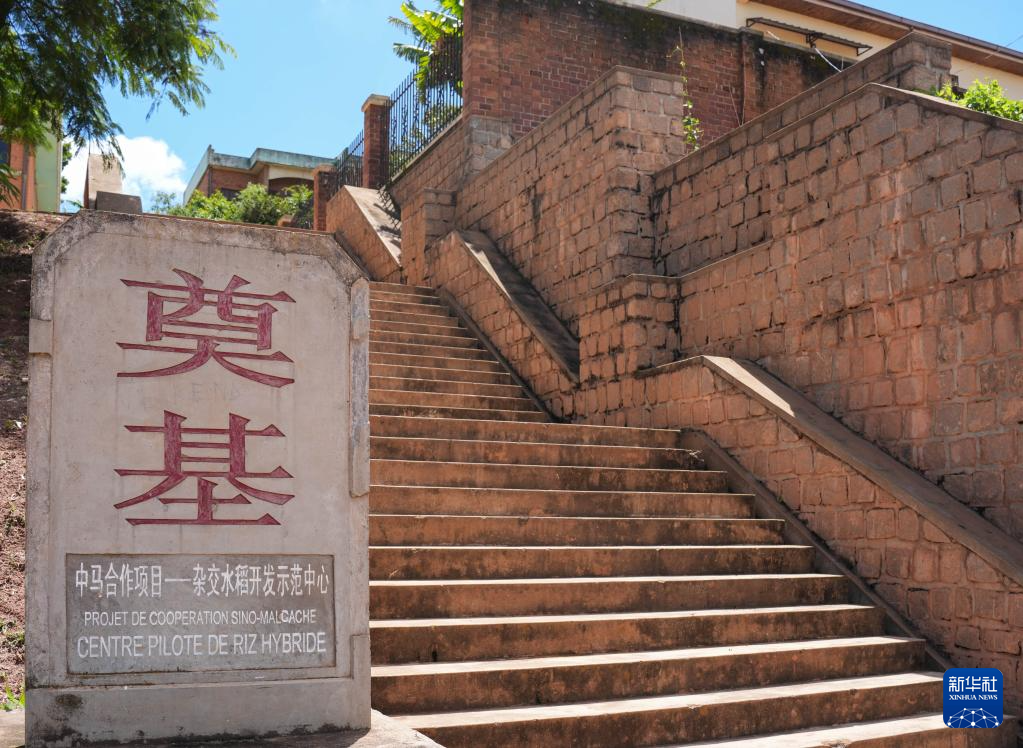 This is a photo taken on March 26th in the town of Mahizi, Madagascar, of the China Malaysia Hybrid Rice Demonstration Center. Photo by Xinhua News Agency reporter Li Yahui
Chinese enterprises have extended the industrial chain
In April, the Hawaiian orchard in Muraya County, Kenya, experienced a bountiful harvest. The morning mist has not dissipated yet, and the fruit farmers are already picking fruits. In the distance, trucks from the Kenyan branch of Hunan Jianglai Food Co., Ltd., a Chinese enterprise, are loaded with fresh fruits purchased and heading towards the processing base.
Kenya’s macadamia fruit enjoys a high reputation in the international market, and prices have continued to rise in recent years. However, most local enterprises still remain in the primary processing stages such as shell removal, lacking deep processing capabilities such as grading, seasoning, and packaging, resulting in low product added value. In addition, fluctuations in export policies have long limited the profits of fruit farmers and enterprises.
By targeting high-quality local raw materials, Jianglai Food invested nearly 30 million yuan in 2023 to establish a production base for macadamia nuts, introducing advanced processing equipment and technology to carry out deep processing operations such as peeling and grading of macadamia nuts, and then exporting them to the Chinese market. According to Wu Huazhong, the purchasing manager of the branch, the base has already started trial production and is expected to be officially put into operation in the second half of the year. The production capacity will reach 6000 tons in 5 years.
John Mwangji, a local procurement personnel of the branch, stated that the investment and construction of factories by Chinese enterprises in the local area has promoted the upgrading of equipment and technology of local processing enterprises, helped farmers increase their income, and achieved a win-win situation.
The 400 fruit trees planted by local fruit farmer Jane Mbulu had a bountiful harvest last year. She said, “Chinese enterprises guide us to improve our planting technology through strict quality standards
In the semi-arid region of southwestern Madagascar, goat farming accounts for over 80% of the country’s total. However, due to limited domestic demand and weak industrial foundation, local goat farming has long been limited to small-scale family operations, making it difficult to achieve large-scale development.
In 2023, Zhongma Animal Husbandry (Madagascar) Co., Ltd., a Chinese enterprise, established its first lamb slaughtering and processing plant in the local area according to Chinese standards, with a designed annual production capacity of 10000 tons, and is expected to achieve full production within 3 years. In 2024, the first batch of 900 kilograms of frozen lamb meat from China and Malaysia Animal Husbandry arrived in Hunan, China. At present, the company has established a complete industrial chain covering tropical grass planting, breeding, slaughtering, processing and export. Anundelaka praised that this factory will effectively promote the development of Madagascar’s livestock industry and help extend the industrial chain.
Looking ahead, he said, “We will seize the opportunities in the Chinese market, accelerate the modernization of animal husbandry, and continue to write a new chapter in agricultural cooperation between Africa and China
 On March 27th, in the Analamanga District of Madagascar, Michel Anondraka, Director General of Agriculture and Livestock at the Ministry of Agriculture and Livestock of Madagascar, was interviewed by Xinhua News Agency. Photo by Xinhua News Agency reporter Li Yahui
 This is a drone photo taken on February 20th in West Asia County, Kenya, of the Kenya National Rice Planting Pilot Zone and Irrigation Canal. Photo by Xinhua News Agency reporter Li Yahui
 This is the water intake of the irrigation and flood control project in the lower reaches of the Enzoa River, captured on February 20th in West Asia County, Kenya. Photo by Xinhua News Agency reporter Li Yahui
 On April 5th, farmers were picking macadamia nuts in a Hawaiian orchard in Muraya County, Kenya. Photo by Xinhua News Agency reporter Li Yahui
 On March 27th, in the Analamanga district of Madagascar, staff from Zhongma Livestock (Madagascar) Co., Ltd. gathered their flocks in the weighing area. Photo by Xinhua News Agency reporter Li Yahui
 This is a photo taken on October 6, 2024, in the Analamanga District of Madagascar, of the lamb slaughter and processing plant established by China Madagascar Livestock (Madagascar) Co., Ltd. (drone photo). Xinhua News Agency (photo provided by China Malaysia Animal Husbandry (Madagascar) Co., Ltd.)