
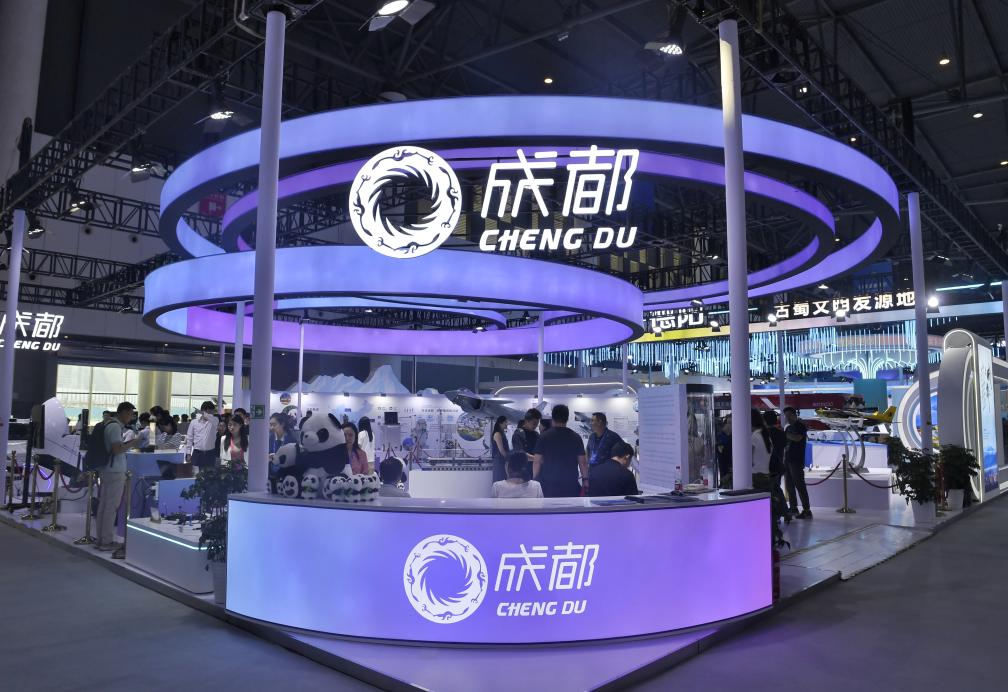
On June 11, the second “the Belt and Road” Science and Technology Exchange Conference was opened in Chengdu, Sichuan, with the theme of “jointly building an innovative road, promoting cooperative development – jointly building a” the Belt and Road “science and technology innovation community”. Photo by Xinhua News Agency reporter Liu Kun
Chengdu, June 12 (Xinhua) — Agricultural technology personnel from Kunming, China have helped local farmers breed high-yield cassava varieties that are water-saving, labor-saving, and adaptable in cassava orchards in Laos; On the Ya’an Wanzhou High speed Railway, the first high-speed railway in Southeast Asia, the large track maintenance machinery equipped by China Railway Construction Corporation is ensuring the smooth operation of the line… Science and technology from China is increasingly becoming an important engine to promote the industrial upgrading of countries jointly building the “the Belt and Road”, continuously improving the level of local industrial development.
“Chinese technology is helping countries along the Belt and Road to consolidate their industrial base and establish a fair industrial system of global cooperation.” Alexander Usbinsky, director of the Belarusian National Technology Transformation Center, said that in Belarus, Chinese high-tech enterprises are carrying out in-depth cooperation with local counterparts in new energy, mechanical equipment, big data, artificial intelligence, industrial Internet and other fields.
In Saudi Arabia, where water resources are scarce, the region has long relied on water meter equipment from European and American companies. In 2024, the ultrasonic water meter intelligent factory jointly built by Chinese enterprise Qingdao Jicheng Electronics Co., Ltd. and local enterprises was officially put into operation. It not only achieved localized production of water meters and greatly improved the efficiency of water resource management in Saudi Arabia, but also sold its products to Middle Eastern countries such as Qatar and Oman.
“We will also explore ways to promote the standards and management experience of China’s water industry to more countries along the the Belt and Road,” said Han Feizhou, chairman of Qingdao Jicheng Electronics Co., Ltd.
At the second “the Belt and Road” Science and Technology Exchange Conference held in Chengdu, Sichuan Province, many participants said that it would be an important direction for future cooperation to promote the benefits of scientific and technological achievements to people all over the world and build an open, inclusive, and mutual learning mechanism platform.
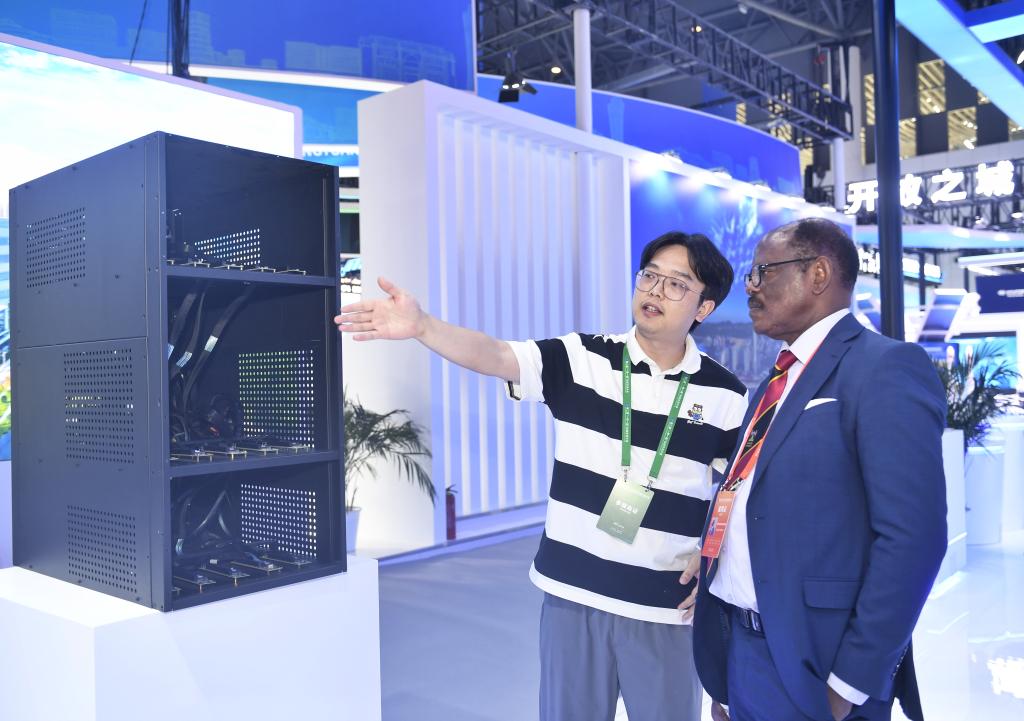
On June 11th, exhibitors introduced their high-performance GPU servers to foreign guests. Photo by Xinhua News Agency reporter Liu Kun
At the conference, China announced the launch of the construction of the “the Belt and Road” international technology transfer center in Chengdu Chongqing region. It plans to build more than 20 international technology transfer nodes with countries jointly building the “the Belt and Road” within three years, and promote more than 100 international cooperation projects.
“China’s scientific and technological innovation force has shown unprecedented vitality and potential. As an enterprise focusing on global technology transfer and regional innovation ecological construction, we are very concerned about the” two thousand “plan for scientific and technological cooperation in the” the Belt and Road “region of Chengdu and Chongqing, China launched at the conference.” Bertram Laumuler, president of German Shitaibai Technology Management Co., Ltd., said.
The plan points out that by 2030, Chengdu Chongqing region of China will implement a total of 1000 science and technology exchange and cooperation projects for countries jointly building the “the Belt and Road”, and support the two-way exchange of 1000 young scientists.
We will build a chain of technology introduction, local transfer, industrial upgrading, and product globalization around the key areas of artificial intelligence, medical health, low altitude economy, and high-end semiconductor in the Chengdu Chongqing region.
“Chinese enterprises are transforming from traditional product trade and joint research and development to the export of key intermediates, production capacity lines, supply chain and standard management.” Liu Xiaohui, deputy director of the China SCO Technology Transfer Center, said that this has not only improved the efficiency of international cooperation, lowered the threshold for cooperation, but also helped build the “the Belt and Road” countries and cultivate local brands.