
On the 22nd, the “2025 ‘the Belt and Road’ University Alliance 10th Anniversary Conference and Cooperation Forum” hosted by Lanzhou University opened in Dunhuang, Gansu Province, the ancient county of the Silk Road. Nearly 200 experts and scholars from more than 20 countries including China, Kazakhstan, Uzbekistan, and Pakistan have conducted in-depth discussions on strengthening cooperation in higher education, science and technology, and other fields.
In 2015, Lanzhou University, together with 47 universities from the “the Belt and Road” countries, launched the “the Belt and Road” University Alliance in Dunhuang, aiming to jointly build a community of higher education. Ma Xiaojie, Secretary of the Party Committee of Lanzhou University, introduced that in the past decade, the “circle of friends” of the alliance has been continuously expanding, and now covers 197 universities in 27 countries and regions.
“Under the impetus of the alliance, we have cultivated a large number of knowledgeable professionals who have integrated Chinese and foreign knowledge for the joint construction of the the Belt and Road. At the same time, focusing on the common challenges facing mankind, we have conducted in-depth joint research in important fields such as agricultural science and technology, ecological governance, and meteorological services.” Ma Xiaojie said.
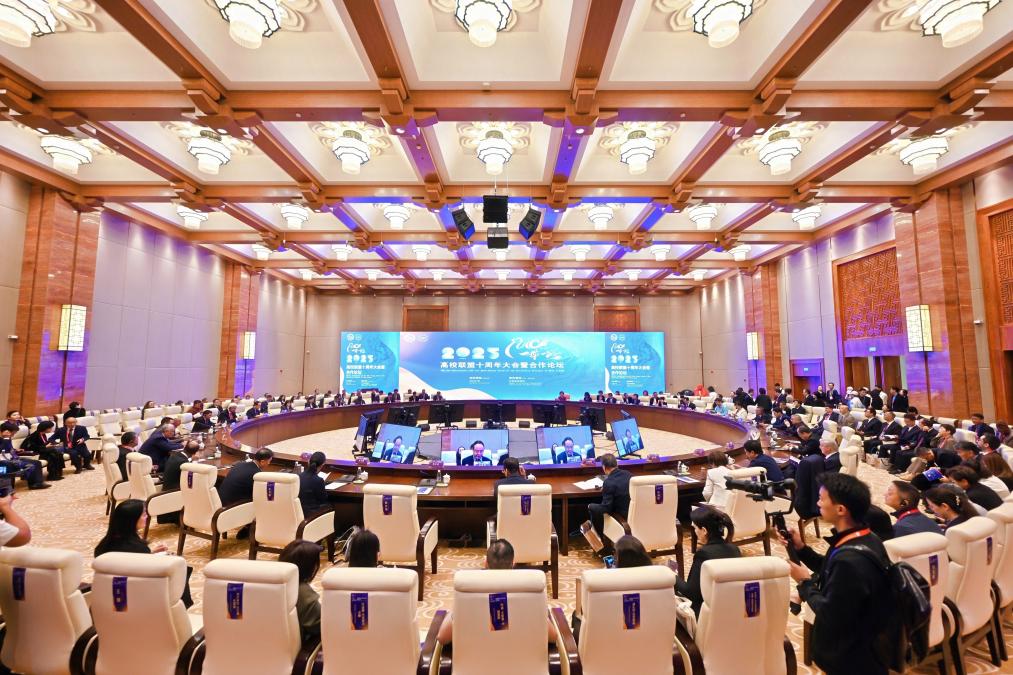 On September 22nd, experts and scholars from various countries held discussions on-site at the forum. Shen Jizhong
The “the Belt and Road” education exchange and cooperation have “blossomed” in many fields. Data shows that in the past ten years, a total of 101 foreign students from countries have gone to Lanzhou University for further study, of which 93% are from countries that jointly build the “the Belt and Road”.
Miao Ruoyu, an international student from Uzbekistan, graduated from Lanzhou University in 2019. After returning to China, she applied to Huawei Uzbekistan headquarters and grew up to become the Business Environment Affairs Manager of Huawei Uzbekistan.
Today, many talents like Miao Ruoyu who studied in China are contributing to the joint construction of the “the Belt and Road”.
In the experimental field in Kenya, Willie, who had studied abroad in China, is applying the ridge and furrow plastic film covering technology taught by Chinese teachers in practice. He studied agricultural technology under Professor Xiong Youcai from the School of Ecology at Lanzhou University. Willie said that China’s grain production increasing technology has achieved good results in experimental fields.
Over 2000 years ago, the Silk Road built a bridge for friendly exchanges between the East and the West. Entering a new era, the “the Belt and Road” initiative has once again built a platform to promote dialogue and cooperation among countries around the world.
Zhao Lei, Deputy Director of the Department of International Cooperation and Exchange of the Ministry of Education, said that educational exchanges and cooperation are an important part of the joint construction of the “the Belt and Road”. “It is hoped that the ‘the Belt and Road’ university alliance can further play its role as a platform link to promote higher quality and more sustainable education exchanges and cooperation.”
It is reported that in recent years, the inter university cooperation between Chinese universities and universities in the countries jointly building the “the Belt and Road” has been deepening. The excellent engineering colleges built in cooperation have landed in Brazil, Kazakhstan and other countries. The construction of cooperation platforms such as the China Russia Institute of Basic Sciences and the China Malaysia International Institute of Higher Studies has been progressing in an orderly manner. The cooperation in higher education under multilateral frameworks such as China Central Asia, China ASEAN, and SCO has achieved positive results.
Experts at the meeting believed that China and the countries jointly building the “the Belt and Road” had achieved remarkable results in promoting higher education cooperation, strengthening scientific research exchanges and other aspects. They hoped that there would be more targeted top-notch talent training methods in the future to provide talent and intellectual security for the economic and social development of the countries jointly building the “the Belt and Road”.
Today, international cooperation in the field of higher education and scientific research has become a vivid practice of promoting people to people connectivity in the the Belt and Road Initiative.
Based on the similarities between Central Asian and South Asian countries and Gansu in terms of ecological environment, as well as research accumulation in the field of grassland and yak, Long Ruijun, professor of the School of Ecology of Lanzhou University, popularized China’s fine forage varieties to Pakistan and Bhutan, alleviated the shortage of winter livestock forage in some regions of the two countries, and provided a “China plan” for the joint construction of the “the Belt and Road” countries to improve people’s livelihood.
“We hope to share China’s technological advantages and scientific research achievements with more countries that jointly build the” the Belt and Road “.” Long Ruijun said that Lanzhou University has promoted more than 10 technologies such as water-saving irrigation and ecological restoration to countries that jointly build the “the Belt and Road”.
Dunhuang, a hub city of the ancient Silk Road and a major hub of commerce and culture, is where Eastern and Western cultures blend and coexist. Today, starting from Dunhuang again, universities from China and countries jointly building the “the Belt and Road” have gathered more cooperation consensus.
Gulichehla Rikhieva, President of Tashkent State Oriental University of Uzbekistan, said that she hoped that in the future, the Alliance would continue to explore cooperation potential in inter school exchanges, collaborative research, mutual visits between teachers and students, and promote high-quality development of the “the Belt and Road” initiative.