
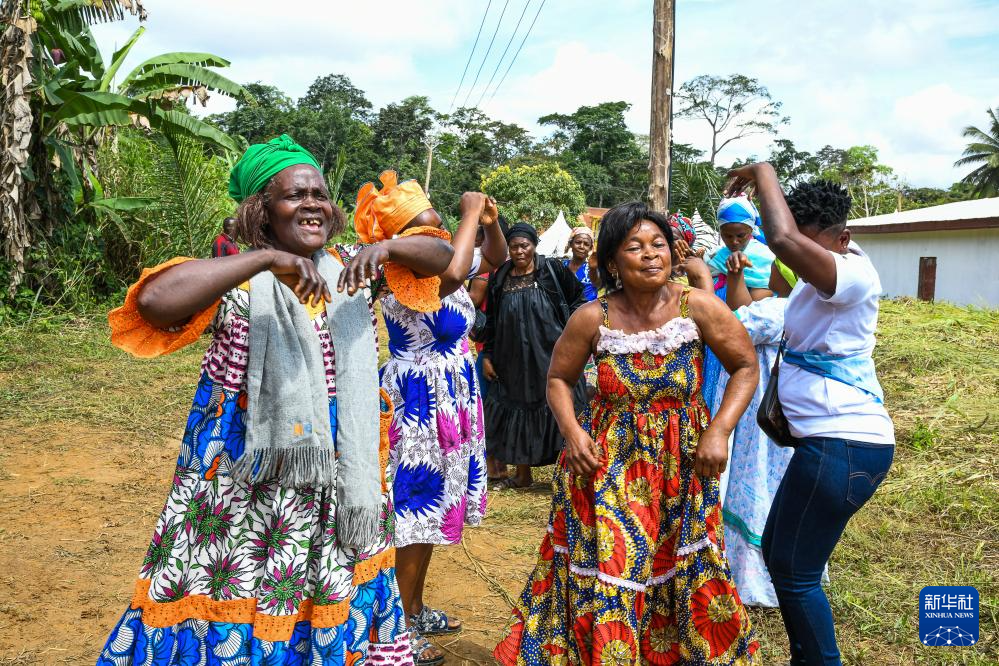
 On October 8th, in Songmingbias Village, Cameroon, villagers celebrated the official launch of a rural off grid solar power station project built by a Chinese enterprise. Xinhua News Agency (Photo by Science Popularization)
Yaound é, October 17th (Xinhua) — Title: Empowering Development through Green Cooperation between China and Non China from the Perspective of Photovoltaic Applications
Xinhua News Agency reporter Wang Ze
In early October, villagers in several villages in the tropical rainforest of central Cameroon celebrated the official launch of a rural off grid solar power plant project built by a Chinese enterprise, singing and dancing. The night light here is no longer just starlight and moonlight. Villagers can finally cheer for the national team’s “indomitable lion” under the lights and in front of the TV.
Photovoltaic panels are spread out in rainforests and deserts, lighting up people’s lives. Nowadays, photovoltaic panels scattered throughout the scorching land of Africa absorb sunlight and convert it into electricity, not only helping to promote the green transformation of Africa’s energy structure, but also profoundly changing the lives and future of local people.
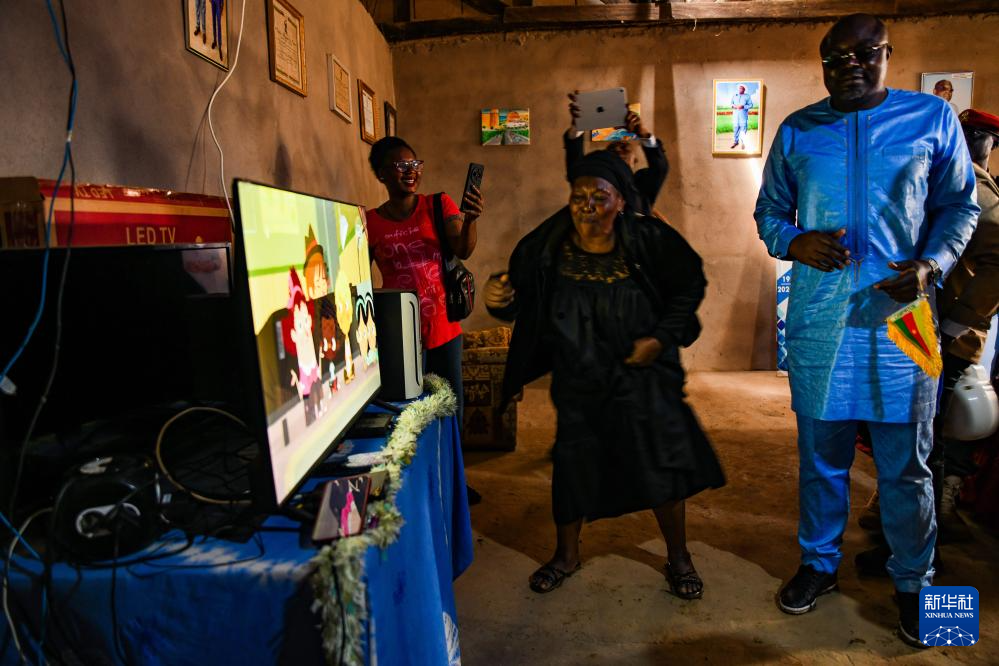 On October 8th, in the village of Songmingbias in Cameroon, people were watching TV programs at home. Xinhua News Agency (Photo by Science Popularization)
Chinese photovoltaic products enter African households
For a long time, the problem of power shortage has been plaguing the capital of the southwestern region of Cameroon, Buea, and other areas. Resident Emmanuel Tabe said, ‘There are occasional power outages here, sometimes even for two or three consecutive weeks. The refrigerator cannot be used, food spoils, and children cannot do their homework at night.’.
Now, all of this has become the past. Thanks to Chinese photovoltaic products, solar street lights can be seen everywhere on the streets of Buea, and many houses have installed photovoltaic panels on their roofs. Tabe is affectionately known as the “Chinese Sun Hero” for being the first to introduce Chinese photovoltaic products.
About 8 years ago, he began to learn about photovoltaic products and subsequently went to China multiple times to purchase, use and start selling them in Cameroon. Now, his home lighting, cooking, and household appliances all use solar energy. The biggest advantage is that we have electricity every day, “he said. Photovoltaic products from China are of high quality and affordable, and are very popular.
Dixon Enjamxi, who also sells solar products in Buea, said that because the streets are bright, the sense of security at night is greatly enhanced. In the past, people dared not go out at night, but now people are willing to come out and engage in activities at night, and the nighttime economy has also begun to develop, “said the 33 year old businessman.
Customer Mary Enji said that Chinese photovoltaic products have improved her life when purchasing energy storage batteries. I use solar energy to pump water and cook, which is very convenient and affordable. Now I am no longer afraid of power outages
Another customer, Dieudone Mbappe, shares the same sentiment. Since we have these solar panels, we have electricity day and night, children can study at night, and life has become much simpler
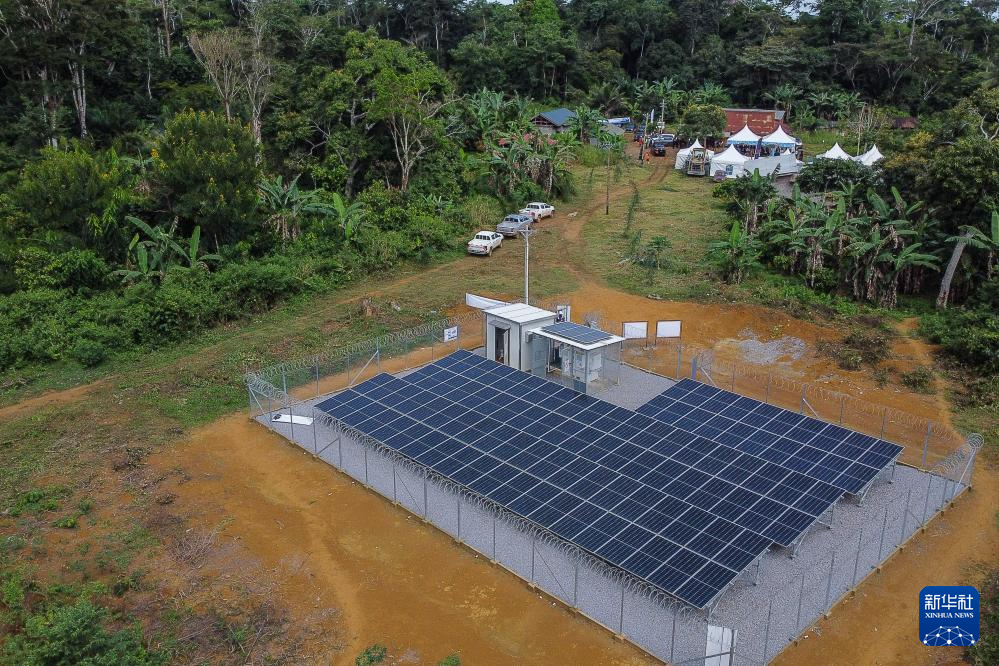 This is a solar power plant (drone photo) taken on October 8th in the village of Songmingbias, Cameroon. Xinhua News Agency (Photo by Science Popularization)
Photovoltaic power generation supports the development of African countries
In the city of Binbo, about 9 kilometers west of the capital of the Central African Republic, Bangui, an endless sea of trees surrounds a square field of about 160000 square meters, where more than 30000 solar panels, two meters long and one meter wide, are neatly arranged to form a cobalt blue “giant mirror”.
It is precisely through this “giant mirror” that the abundant solar energy in the local area is converted into electricity, which is then continuously transmitted to factories, schools, and thousands of households in Bangui through facilities such as combiner boxes, booster stations, and power grids.
This is the first photovoltaic power station in the Central African Republic – the Sakai Photovoltaic Power Station. The power station is contracted by Tianjin Electric Power Construction Co., Ltd. of China Energy Engineering Group, with an installed capacity of 15 megawatts. Its completion effectively alleviates the electricity shortage in Bangui.
Official data shows that this power station meets about 30% of the electricity demand in the city of Bangui. Emanuel Boris Yandougee, a 32 year old resident of Bangui, said, “The nighttime economy has developed. My family runs an evening restaurant, and the ‘solar farm’ has brought new vitality to this place.
The Chinese photovoltaic industry is continuously providing power support to African countries. In Kenya, the Garissa 50 MW photovoltaic power station constructed by Chinese enterprises was officially put into operation in 2019, which can meet the electricity needs of more than 380000 people in 70000 households and effectively alleviate the local “electricity shortage”; In Zambia, the largest single photovoltaic project with installed capacity, the Kabwe 100 MW photovoltaic power station project, held a grid connection ceremony in June this year. It is expected to generate approximately 180 million kilowatt hours of electricity annually, providing stable and reliable power support for Zambia’s mining modernization and agricultural development.
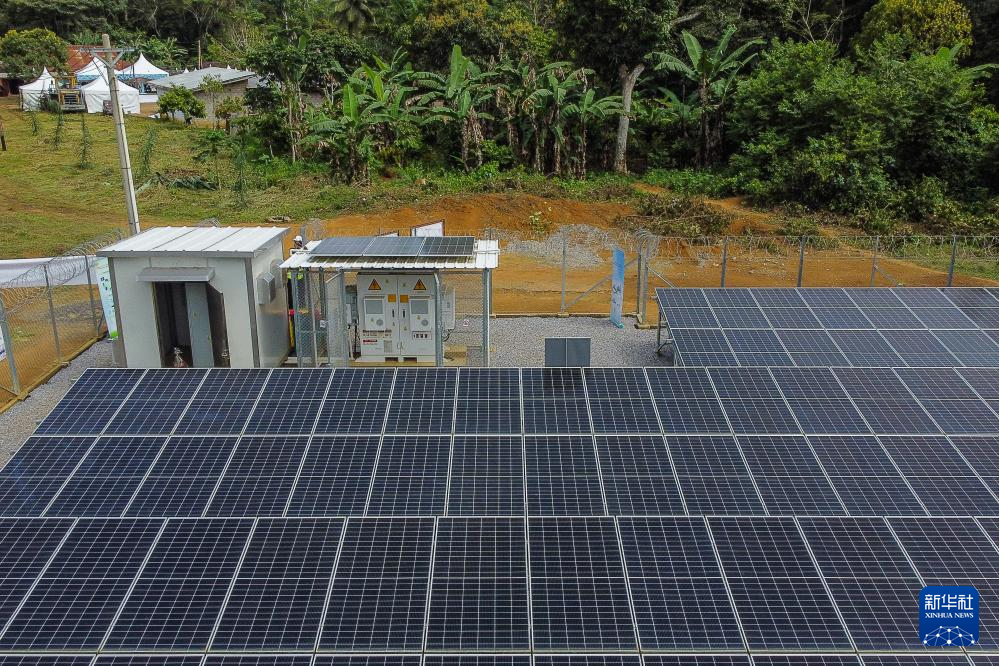 This is a solar power plant (drone photo) taken on October 8th in the village of Songmingbias, Cameroon. Xinhua News Agency (Photo by Science Popularization)
Building a greener and better future together
China has long supported green development in Africa, and the cumulative installed capacity of photovoltaic power stations built through China Africa cooperation alone has exceeded 1.5 gigawatts.
China Africa cooperation in the field of clean energy continues to advance. China officially launched the “African Light Belt” South South Cooperation Project at the Africa Climate Summit in September 2023, aiming to use the advantages of the photovoltaic industry to help Africa cope with climate change, while solving the problem of electricity and lighting for impoverished households without electricity, and helping Africa truly embark on a green and low-carbon development path.
Majitolum Timotai, a resident of the small town of Doba in southern Chad, told reporters that he looks forward to the “African Light Belt” entering his hometown as soon as possible. We hope this project can improve our lives and revitalize our production, and I am confident about it
In Cameroon, Huawei Cameroon is advancing the third phase of a rural off grid solar power plant project. Since signing a contract with the Ministry of Water Resources and Energy of Cameroon in 2012, the project has constructed and completed nearly 500 off grid solar power stations for commercial use, with a total installed capacity of 32.8 megawatts and an annual cumulative power generation of 47.9 gigawatt hours.
The project manager Li Yanqing said, “These photovoltaic power stations not only provide electricity to villagers, but also share excess electricity with local communication operators to ensure mobile signal coverage in rural areas. These power stations can reduce carbon dioxide emissions by 36000 tons per year, equivalent to planting 100000 trees.
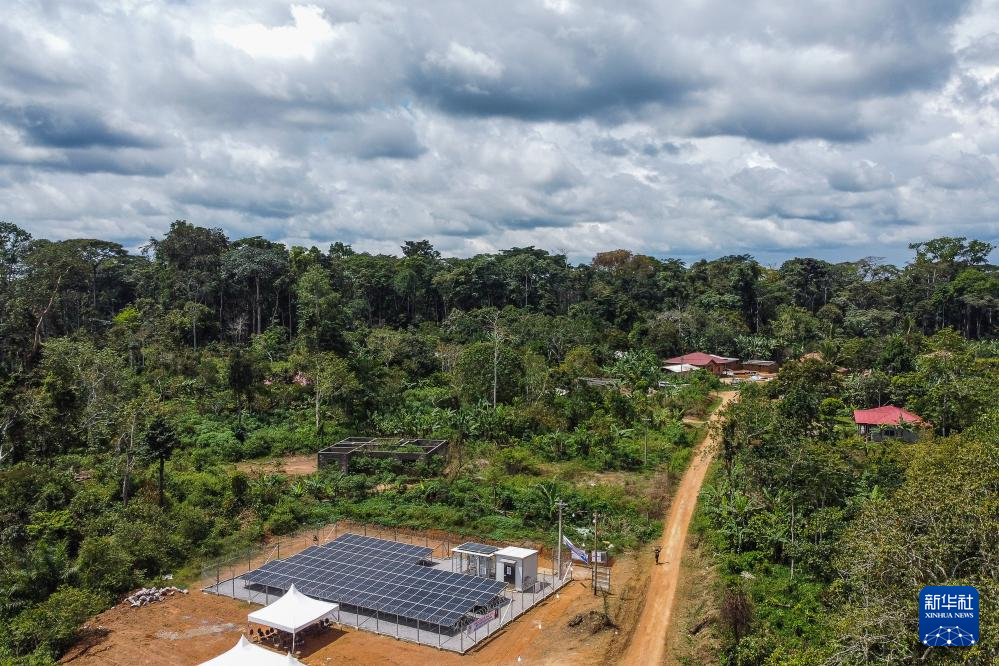 This is a solar power plant (drone photo) taken on October 8th in the village of Songmingbias, Cameroon. Xinhua News Agency (Photo by Science Popularization)