
Kuala Lumpur, October 28th (Xinhua) – Journalist’s note | How can durian foodies “speed up” the Malaysian durian season
In October, Malaysia welcomed the durian harvest season, with well-known durian varieties such as “Cat Mountain King”, “Black Thorn”, and “Sultan King” making their debut. How can Chinese diners taste the freshest, most enticing, and flavorful durian of this season? More intensive round-trip flights between China and Malaysia, faster cross-border logistics clearance, and technology enabled precise grading – these measures have promoted the upgrading of durian quality in the Chinese market.
Durian is accelerating towards China. In August 2024, the first flight loaded with fresh durian arrived at Zhengzhou Airport by Zhongyuan Longhao Airlines, embarking on a new journey of fresh durian on the “Air Silk Road”. Nowadays, in durian producing areas such as Raub and Wendong in Pahang, Malaysia, many orchards have launched “direct airport” services. After the durian matures and lands, it is immediately packed and shipped to China, shortening the time from fruit trees to dining tables like never before.
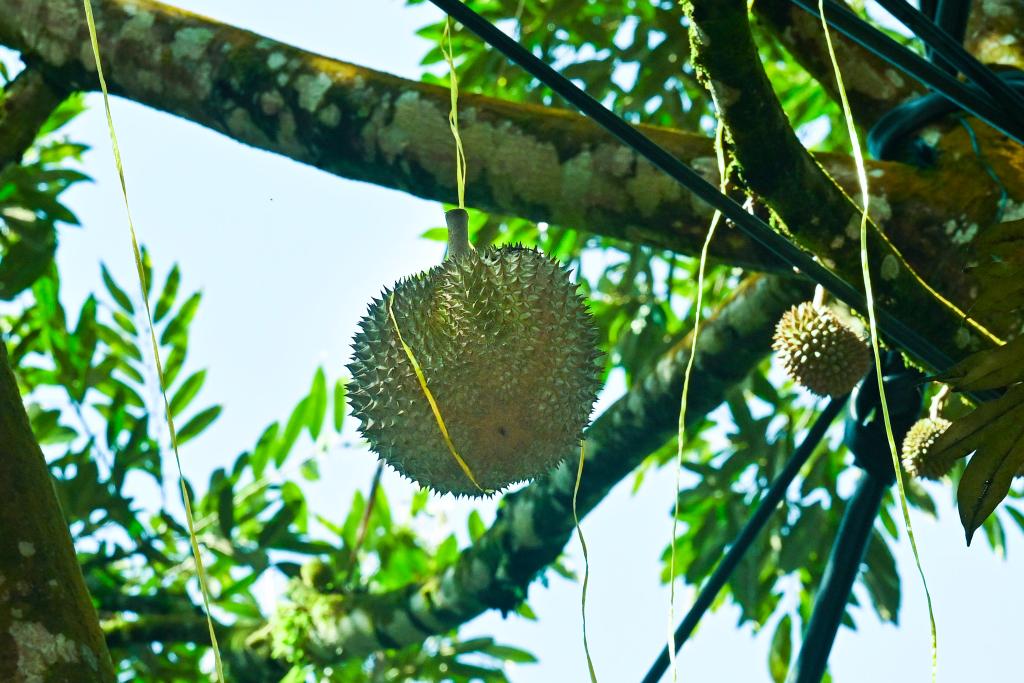 This is a mature Cat Mountain King durian captured on October 16th in Raub, Pahang, Malaysia. Photo by Cheng Yiheng, Xinhua News Agency reporter
In recent years, over 70% of Malaysia’s durian exports have been shipped to China, “said Zhang Jianhao, Secretary General of the Malaysia International Durian Industry Development Federation. China is one of the world’s largest durian consumer markets. Malaysia began exporting frozen durian products to China in 2011, and began exporting frozen whole durian with shells to China in 2019. In 2024, the two countries signed the Protocol on Phytosanitary Requirements for Fresh Durian Imported from Malaysia to China, opening the door for the export of fresh durian from Malaysia to China. The continuous expansion and opening up of the Chinese market not only drives the growth of Malaysia’s durian industry exports, but also promotes the rapid development of Malaysia’s durian processing, packaging, and logistics sectors, “he said.
More than 30 local employees are busy working on the assembly line in the durian fresh fruit sorting and packaging workshop of Yuli Import and Export Co., Ltd. located in Selangor. Fresh durians are delivered to the factory by refrigerated trucks, processed, and then transported directly to the airport by refrigerated trucks. Through the ‘aviation cold chain+cross-border customs clearance’ model, it is possible to directly reach cities such as Guangzhou, Shanghai, and Shenzhen in China, with a maximum travel time of only 36 hours, “said Xie Mingfa, the company’s head.
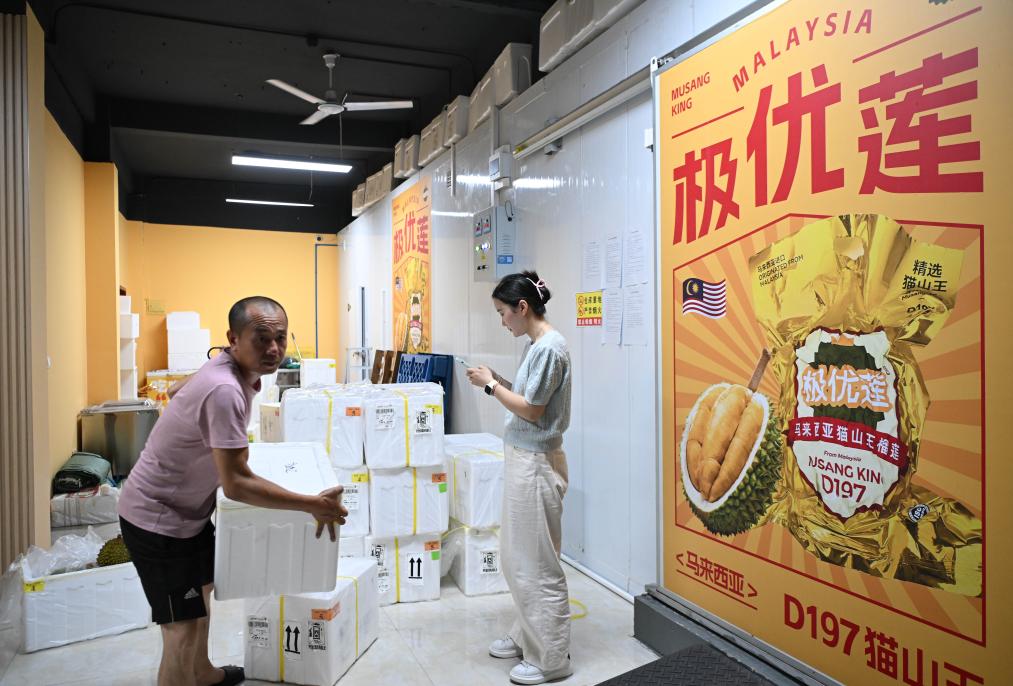 On October 17th, at the operation center of a fruit distributor in Baiyun District, Guangzhou, staff sorted out freshly arrived durian fruits. Photo by Deng Hua, Xinhua News Agency reporter
Nowadays, a naturally ripe Maoshan King durian fruit can be delivered to Chinese consumers within 36 hours after harvesting. This was unimaginable many years ago, “said Zhang Jianhao.” In the past, only large exporters could bear the high logistics and customs clearance costs. Nowadays, more and more small and medium-sized enterprises can also try the ‘small batch order+high-frequency delivery’ model through e-commerce platforms or B2B procurement chains, allowing products to directly reach the multi-level market in China and expand market coverage
Of course, the experience of tasting on site is even better. In the arrival hall of Kuala Lumpur International Airport, passengers from China pushed their suitcases out, and many people excitedly discussed “which cat mountain king is more affordable and which durian is the best”.
Wang Qi, a passenger from Beijing, smiled and said, “I’ve heard for a long time that the quality of durian in Malaysia is very good, and there are many varieties that are not common in China. Eating durian is an important part of my itinerary when I come to Malaysia this time
With the continuous upgrading of China Malaysia relations, the two countries are working together to create a new “golden 50 years”, with continuous expansion of round-trip routes and increasingly dense connectivity networks. According to the flight schedules issued by several airlines in China, at present, the regular flights from Chinese Mainland to Malaysia exceed 500 every week. The routes not only cover first tier cities such as Beijing, Shanghai and Guangzhou, but also extend to Fuzhou, Qingdao, Xi’an and other places. In addition, the mutual visa exemption policy makes it possible to leave at will, from booking tickets to clocking in at durian stalls, it only takes “half a day” at the fastest.
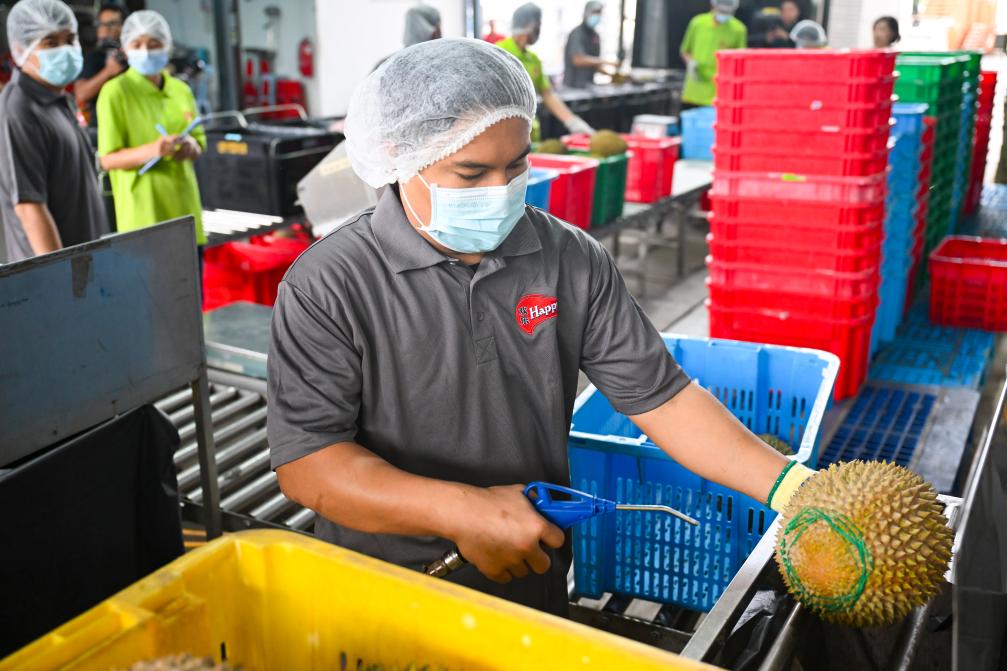 On October 16th, at a durian processing plant in Selangor, Malaysia, staff prepared to conduct a preliminary cleaning of the sorted durians. Photo by Cheng Yiheng, Xinhua News Agency reporter
Thanks to visa free travel and the addition of new routes, the proportion of visiting passengers between Malaysia and China continues to increase, “said Gao Yashuang, General Manager of Xiamen Airlines Kuala Lumpur Office. In recent years, Xiamen Airlines has added new routes such as Penang Xiamen and Kuala Lumpur Chongqing, and plans to open the Quanzhou Kuala Lumpur route before the end of the durian season.” We hope to create the first opportunity for more domestic durian fans to come to Malaysia and ‘grab fresh food’ by continuously expanding our route network.
The fragrance of Malaysian durian is just right, and domestic practitioners are also busy reshaping the definition of “quality” with technology. Entering the sorting workshop of the Ningbo Smart Durian Center of the City Ship, the reporter saw that the staff placed the complete durian on the conveyor belt of the large scanning imaging equipment. After a moment, the internal structure of the fresh durian fruit was clearly displayed on the electronic screen: the number of rooms, weight, meat yield, insect infestation situation, etc. were all clear at a glance.
The newly delivered durian has been determined by the system as “product standard: unqualified”, based on “abnormality: insect fruit”; The S-grade fruit next to it clearly displays six full fruit pulp, and the meat yield data is automatically calculated and generated by the system. Circular charts, bar charts, and data reports flash synchronously on the screen, and each durian is given a unique “digital portrait”.
This set of equipment and algorithm system together form the “Durian Detective” non-destructive quality inspection system, which achieves three-dimensional non-destructive testing of durian quality. The entire process information from orchard picking to terminal sorting can be traced.
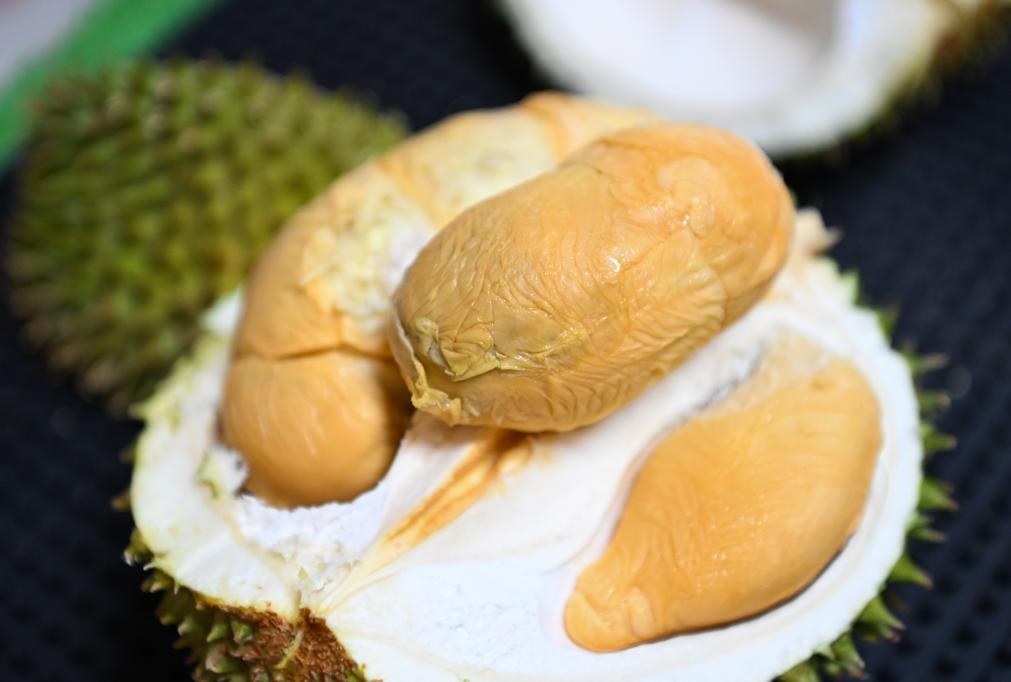 This is a photo taken on October 17th at the operation center of a fruit dealer in Baiyun District, Guangzhou, of the flesh of Malaysian black spined durian. Photo by Deng Hua, Xinhua News Agency reporter
Previously, quality was judged by the experience of fruit farmers, but now technology has made testing more accurate and controllable. “said Wang Jiaqiang, founder of the durian testing equipment development company, Shibaoshi Group. The company plans to expand the equipment to Johor, Pahang, and Kedah in Malaysia next year.
Wang Jiaqiang told reporters that durian testing is just the starting point. Similar AI detection system can also be extended to more than 30 tropical fruits such as jackfruit, mangosteen, coconut, etc. in the future to achieve cross category quality traceability management. Through these technological innovations, we hope to help more BRICS partner countries connect their high-quality agricultural products to the international market
Nowadays, the “durian passage” between China and Malaysia is becoming faster, more stable, and smarter, with people flying to eat and fruits flying to supply. Flights are denser, customs clearance is faster, and detection is more accurate, allowing this unique fruit aroma that crosses the ocean to continue drifting further away with the empowerment of technology and cooperation.