
Dakar, January 25th (Xinhua) – Journalist’s note | “Searching for Water in Senegal Village”
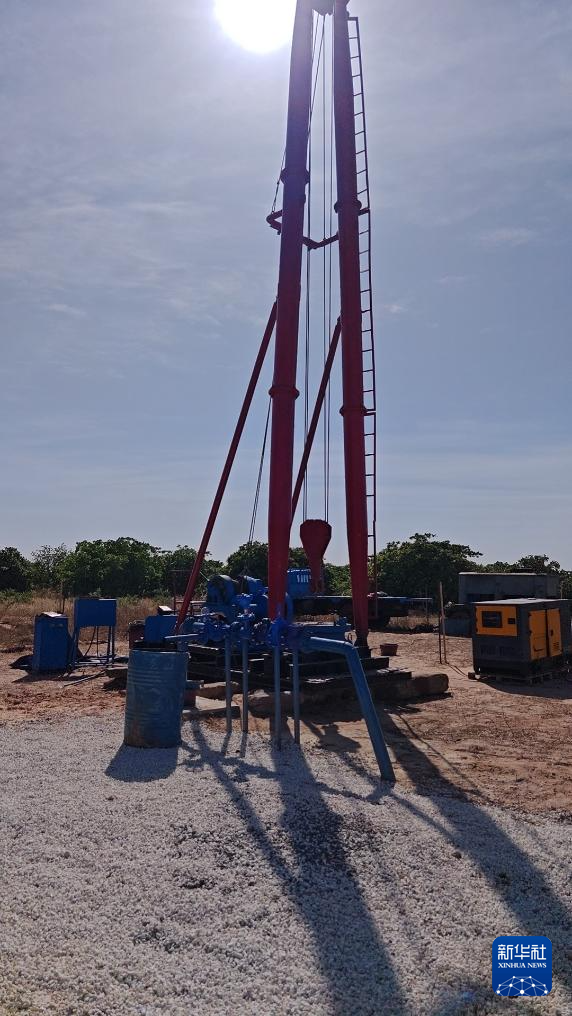 This is a photo taken on January 22nd in Jagele Village, Sokon City, Fatick Region, Senegal, of the well location selected by China Overseas Group Senegal Company through geophysical technology science (mobile phone photo). Xinhua News Agency (photo provided by China Overseas Group Senegal Company)
Driving south from Dakar, the capital of Senegal, into the Fatick region, the color tone on the roadside gradually changes. The light gray saline alkali mudflat is like a paper stretched by the wind. The water mark in the rainy season has been smoothed by the sun, leaving only a thin layer of white. Occasionally, low-lying areas shimmer with water, but up close it seems like a reminder to passersby that there is a shortage of fresh water available at any time.
The more the car drives towards the countryside, the more the baobab tree looks like a road sign. Their trunks are thick and almost clumsy, with branches spreading out freely, like a silent umbrella under the scorching sun. When arriving at the village of Jagele in the city of Sokon, about 270 kilometers away from Dakar, a water tower came into view, and the reporter’s first reaction was surprisingly “another baobab tree”. However, the tree trunk stores its own energy, while the water tower stores the daily life of the village – cooking, drinking water, livestock, vegetable gardens – all relying on the accumulated fresh water to survive the longest drought of the year.
Kang Yue, General Manager of China Overseas Group Senegal Company, said that the precipitation distribution in Senegal shows a clear gradient of more in the south and less in the north, with rainfall mainly concentrated during the rainy season from June to October each year. The annual precipitation decreases from over 1200 millimeters in the south to around 300 millimeters in the north. The dry season is longer, and surface water is more prone to seasonal decline.
He used Jagley Village as an example to introduce that the original water supply system has been in operation for more than 30 years. With the increasing demand for water from residents, the old well was damaged three years ago, and many surrounding villages can only rely on artificial water cellars for temporary storage.
In order to restore stable water supply as soon as possible, the project scientifically selected well locations through geophysical exploration technology and completed construction in a short period of time. The well water supply was connected to the original system to provide water for the people. Kang Yue said that these seemingly ordinary construction processes are related to whether the water supply can be continuous, whether the pressure can meet the standard, and also determine whether the water energy can flow steadily to the village.
The renovation of the water supply system in Jagley Village is one of the components of the second phase of the Senegal rural well drilling project. The project will be launched in February 2025 and implemented by China Overseas Land Group Senegal Company. It plans to build 85 water wells, 89 water towers, 1450 kilometers of pipelines, 300 centralized water supply points in Senegal, and provide water supply to 18200 households.
What truly gives “stability” a touch is the two faucets on the campus of Jaggley Elementary School.
The ground of the campus is covered with sand, but several mango trees on the playground are strong, and children stand under the shade of their trees. Principal Su Aibu Di Yemei pointed to two newly connected water pipes in a corner of the campus and said, “In the past, it took half an hour to cross the road to fetch water from the school gate. The buckets were heavy and the traffic was dense. When children walked on the road, teachers always had a string in their hearts.” Now, the faucet is right in front of the classroom, and when you turn it on, there is water.
At present, this school has a total of 283 students. Di Yemei said that this means’ children no longer have to risk crossing the road just to drink water ‘.
Fifth grade student Albert Manga stared at the reporter for a few seconds, as if recognizing something, and suddenly said “thank you” in Wolof language. In fact, what he really wants to thank is the Chinese workers who connected the faucet to the campus. At that moment, the Chinese face was like the ‘person who brought water’ to him.
On campus, the reporter met Alphonse Faye, who is now 38 years old. He works at a bank in Sokon. On the day of the water supply ceremony at Jagley Elementary School on the 22nd, he specifically rushed back to the village. He recalled that it used to be very troublesome for villagers to use water. They had to walk to the water collection point outside the village, rush and queue up, fill iron buckets, and travel back and forth for nearly an hour. During the dry season, we need to adjust the timing to see if there are many people and if there is still water in the well.
And now, he points to the newly built houses in the village and says that someone has connected the water pipes to their homes. Some people who live in old houses go to centralized water collection points, but the points are closer and the water collection is more orderly. “At least, clean water has steadily flowed into the village.
Senegal’s Minister of Water Resources and Sanitation, Tidiane Di é, stated that the Jagley water supply system currently radiates to 12 surrounding villages, and the second phase of the rural well drilling project aims to bring the water supply conditions in rural areas in line with those in cities. He said that water is the source of life, related to health, well-being, and development prosperity.
On site, the most persuasive words are often not words. At the water supply ceremony, Di é and the Chinese Ambassador to Senegal, Li Zhigang, walked to the edge of the well, clasped their hands together, picked up the cool well water flowing from the faucet, and drank it all in one gulp. The people around laughed. This is like putting a seal on it: water needs to be drunk in the mouth, and “water flow” is considered proof.
Li Zhigang said that China and Serbia are actively promoting the second phase of rural well drilling projects, fully demonstrating the determination of China and Serbia to accompany each other and be “action oriented”. China is willing to continue deepening cooperation with Serbia to benefit the people of both countries.
At the end of the interview, the meaning of “development” became concrete in the eyes of the journalist. Sometimes, ‘development’ may not necessarily be earth shattering changes, but rather quietly resolving the most daily and tedious troubles in a place. At the moment when the water flows out, it also witnesses a brand new beginning: from today on, life in the village can proceed at a different pace.