
 Moscow/Chengdu/Haikou, February 18 (Xinhua) — “New news” under the mutual visa exemption between China and Russia
Russian tour guide Dobrolyubov has been in the industry for over 20 years and recently discovered something new: at many popular tourist attractions in Russia, staff and restaurant servers always ask him about the writing and pronunciation of some Chinese words.
Dobro Liubov studied abroad in China in the 1990s, and his fluent Chinese made him widely popular on Chinese social media, affectionately known as “Adu”. He told reporters that Russian tourism practitioners asked him for advice on Chinese with serious expressions, ‘They are here to better serve Chinese tourists’.
In September and December 2025, China and Russia successively implemented visa free policies for each other, and the Chinese and Russian people embarked on a journey of “leaving at will”.
From the idea of traveling to Moscow to actually setting off, it only took me 10 days. “On the eve of the Spring Festival, Sun Yidan from Jiangsu stood on the snowy Red Square in Moscow, happy like a child. I have always wanted to see heavy snow, and the winter in Russia has fulfilled my expectations
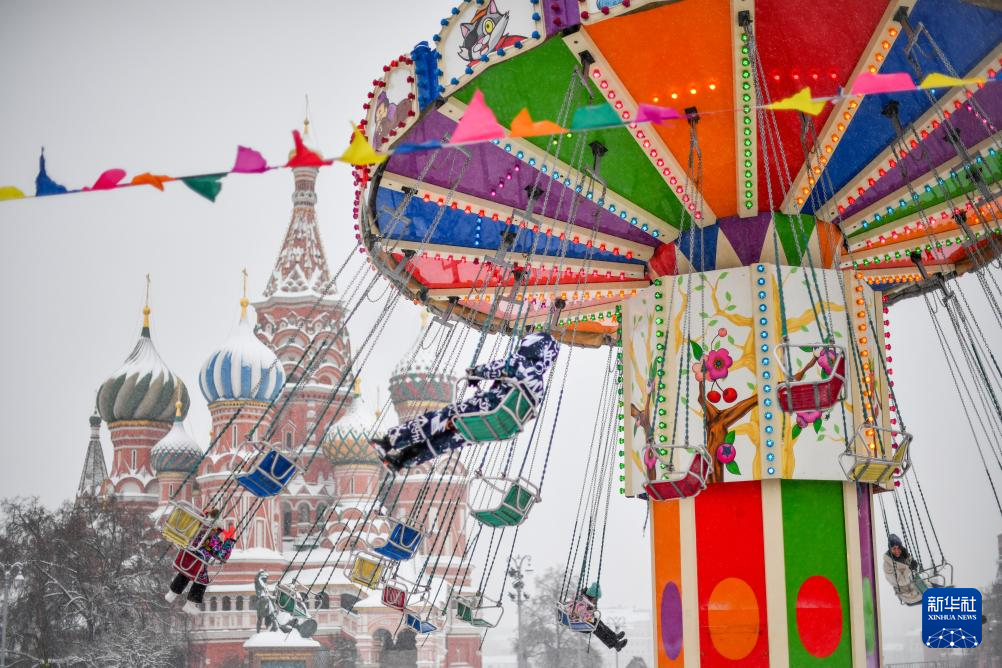 On January 28th, people ride amusement rides on Red Square in Moscow, Russia. Photo by Xinhua News Agency reporter Zhang Chaoqun
In the past month, the number of Chinese tourists traveling to Russia has significantly increased. Zhao Zhiwei, who is going to Russia for the fifth time, said, “In the past, visa procedures were required, but now you can just leave. The entry process is particularly smooth, and the Chinese signage at the airport is even more reassuring
Kondratiev, Director of the Multilateral Economic Cooperation and Special Projects Department of the Russian Ministry of Economic Development, stated that Russia plans to increase the number of foreign tourists entering the country to 16 million by 2030, with an estimated 5.7 million Chinese tourists. Maya Lomizo, Executive President of the Russian Tourism Operators Association, predicts that the number of Chinese tourists visiting Russia in the summer of 2026 will increase by about 30% compared to the same period last year.
At the same time, Russian tourists have listed China as a travel destination, forming a wave of tourism to China. According to data from the Tourism, Culture, Radio, Television and Sports Bureau of Sanya City, Russian tourists account for over 40% of inbound tourists to Sanya. Just one month after the implementation of mutual visa exemption between China and Russia, the Dadonghai Tourist Area in Sanya receives more than 3000 Russian tourists per day. Sanya hotels will receive approximately 170000 Russian inbound tourists in 2024, increasing rapidly to 350000 in 2025.
Chengdu, Leshan and other places in Sichuan have become new “treasure destinations” for Russians to visit China in depth. According to the Chengdu Border Inspection Station of Sichuan Exit Entry Border Inspection General Station, in the past three months since China granted visa free entry to Russia, more than 26000 Russian passengers have entered the country through Chengdu Airport without a visa. No need to apply for a visa, filling out the entry card online can be completed in just a few minutes, and the entire customs clearance process is particularly smooth, “praised Russian tourist Letuchaya.
Russian tourist Svetlana has visited China many times and loves Leshan very much. “Every place in China has its own uniqueness, and people should come to see this great art (the Leshan Giant Buddha Scenic Area),” said Svetlana.
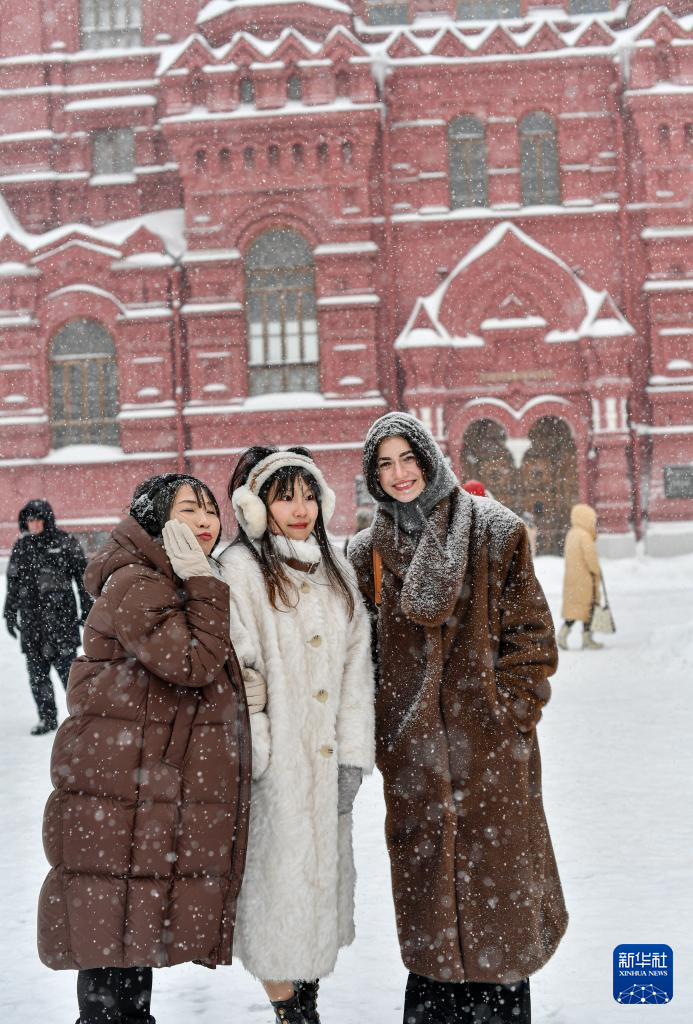 On January 28th, Chinese tourists took a photo with locals on Red Square in Moscow, Russia. Photo by Xinhua News Agency reporter Zhang Chaoqun
Traditional Chinese medicine health and wellness tourism is becoming a new feature for attracting Russian tourists to China. Sanya Hospital of Traditional Chinese Medicine launched a TCM health care project combining tropical climate conditioning, acupuncture and moxibustion and massage, and was equipped with a Russian translator. Its international medical department cooperated with several international insurance companies to achieve direct insurance payment. Many Russian tourists come to this hospital specifically to choose a traditional Chinese medicine treatment course. Hunchun City in Jilin Province, located at the border of China, Russia, and North Korea, has launched a “Traditional Chinese Medicine+Health Care+Vacation” package. At the newly established International Business Department of Hunchun Traditional Chinese Medicine Hospital, 53 year old Russian tourist Alexei said, “I used to have numbness in my hands and feet. Traditional Chinese medicine not only relieves symptoms, but also improves sleep quality
Behind the tourism boom, China and Russia continue to upgrade their service systems around visa free policies, making travel smoother and the experience more enjoyable.
Sanya, Hainan has opened direct international routes to 10 major cities in Russia, including Moscow, St. Petersburg, and Kazan. In 2026, new routes will be added to destinations such as Akira and Irkutsk. Chengdu has 83 regular international and regional direct flight routes, building a “10 hour intercontinental and 5-hour Asian” flight circle and becoming an important hub for personnel exchanges between China and Russia. Siberian Airlines in Russia has increased its flights to and from China.
In Russia, Moscow and other places, optimization is carried out in various aspects such as language communication, signage guidance, and payment services, using details to convey friendliness. At Moscow Sheremetyevo Airport, clear Chinese signage runs through various stages such as customs, security checks, and luggage retrieval.
China’s popular tourist destinations have launched customized services for Russian tourists. The “12345” service hotline in Sanya has set up a dedicated Russian speaking desk, and hundreds of star rated hotels and 11 key scenic spots in the city are equipped with Russian language guides and service personnel. Chengdu focuses on payment convenience, with over 5000 ATMs supporting foreign card withdrawals and 21 overseas electronic wallets available for online payments. The coverage of foreign card payments in key business districts exceeds 90%.
The visa free policy between China and Russia has already benefited fields such as business, culture, and education. Yegorova, a member of the board of directors of Melkom, a Russian grain processing company engaged in trade with China, said that the visa free policy will significantly reduce the time cost for businesses and business negotiations between the two countries. Komlev, Chairman of the Russian digital social platform company Red Soft, said that the visa free policy is conducive to promoting technological exchanges. This year is the “China Russia Education Year”. Zhao Chunlu, the Education Counsellor of the Chinese Embassy in Russia, stated that visa free access plays an important role in promoting educational exchanges between China and Russia. The number of students participating in short-term exchanges has increased, and it has become more convenient for teachers and researchers to visit schools and attend academic conferences. Russian Foreign Ministry spokesperson Zakharova pointed out that the implementation of visa free policy will help further enhance cultural exchanges between the two countries, consolidate traditional friendship, and inject lasting momentum into the development of Russia China relations.
From official policy dividends to spontaneous friendly interactions among the people, mutual visa exemption is helping the Chinese and Russian people build a solid “bridge of friendship”.