
Beijing, August 17 (Xinhua) — Journalist’s note: jointly drawing a new picture of AI health cooperation between China and Africa
At the 31st China International Medical Equipment Exhibition and Technology Exchange Conference held in Beijing from the 15th to the 17th, Chinese experts broke through the limitations of time and space, and provided diagnosis and treatment advice for a child in Africa using heart sound data analyzed by medical big models.
For the treatment of myocardial infarction, the risk of death increases every minute of delay. Tang Yida, Vice President of Peking University Third Hospital, said that the hospital, universities, and enterprises have jointly developed the “Xihe No.1” medical model, which greatly shortens the warning time and reduces the rate of initial misdiagnosis.
This model has been embedded in the “Internet plus Medical Health” Demonstration Zone in Ningxia, China, to achieve cross regional and cross institutional data interaction. Through the data transmission and real-time analysis of AI wearable devices, patients can have more opportunities for survival and recovery during the golden treatment time.
The Central African Hospital Alliance was officially established at the conference. Representatives from China and Africa are sharing new achievements and technologies while depicting a new picture of China Africa health cooperation.
The case shared by Li Zhiqiang, director of the National Children’s Medical Center and the Heart Center of Beijing Children’s Hospital, also impressed African representatives: a sensor smaller than a credit card can be attached to the chest of a newborn to directly transmit heart sound data to the cloud for remote screening, greatly improving sensitivity compared to manual evaluation and reducing misdiagnosis rate to 7.4%.
“In the future, we hope to carry out screening and data analysis of 2 million cases of congenital heart disease in 50 countries jointly building the ‘the Belt and Road’, and jointly build the world’s largest congenital heart disease early warning network.” Li Zhiqiang said.
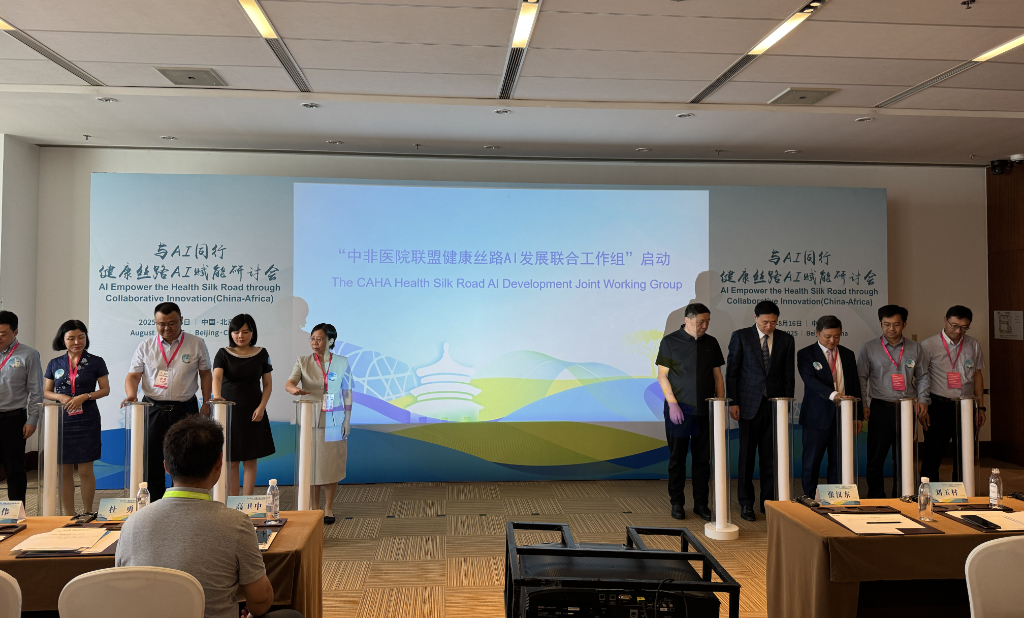 The 31st China International Medical Equipment Exhibition and Technical Exchange Conference sub forum was held on-site. Photo by Gu Tiancheng, Xinhua News Agency reporter
AI greatly saves clinical doctors the energy and time of relying on human eyes to interpret electroencephalography. ”On the computer of Yang Zhixian, director of pediatrics at Peking University People’s Hospital, the electroencephalogram data of epilepsy patients flows like a waterfall. “We look forward to more technological links with AI assistance to benefit every epilepsy patient
Many African representatives expressed their great hope that the directional vibrating belts and guide dog robots showcased at the exhibition can help disabled people in Africa.
In Africa, the combination of mobile CT vehicles and AI imaging diagnosis can effectively compensate for the shortage of local medical staff and their insufficient capabilities. However, there are still many unresolved issues on how to make the promotion and implementation of Chinese technology sustainable. ”The speech by Chen Si, Deputy General Manager of the China Africa Development Fund, resonated with many attendees.
Beijing Boya Quanjian Intelligent Computing Technology Co., Ltd. has participated in the research and development of AI technology in multiple medical institutions in recent years. The company’s chairman, Li Lin, deeply feels that the rapid development of the AI+medical sector in China is due to the acceleration of the entire chain from laboratories to production lines. Continuing to promote AI empowerment, enterprises will embrace more opportunities.
The ‘Chinese solution’ of AI empowering healthcare is crossing the ocean and penetrating deep into the African continent.
After more than 60 years of continuous efforts, China has sent over 23000 medical staff to 53 African countries, assisted in the construction of more than 130 medical institutions, treated over 280 million patients, trained nearly 50000 local medical staff, and established a cooperation mechanism for 45 China Africa counterpart hospitals.
Professor Wang Tao from the Nephrology Department of Peking University Third Hospital pointed out that with the deepening of AI medical intelligent agent technology, how AI can help countries improve their medical service systems requires our joint efforts.
AI cannot replace the love of doctors, but it can spread the love of the human health community even further. ”An African representative from Zambia said.