
Jakarta, May 19th (Xinhua) – The China Indonesia Sustainable Development Exchange and Dialogue on “The New Life of Mangrove Forests” was held in Jakarta, Indonesia on May 19th. Representatives from Chinese and Indonesian government agencies, environmental organizations, research institutions, and the business community attended the meeting and engaged in in-depth exchanges on ecological protection, green transformation, and practical cooperation between China and Indonesia.
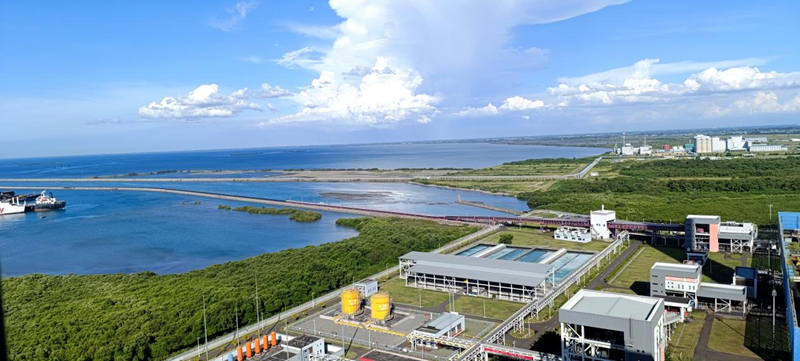 This is a photo taken on May 18th of the Java 7 coal-fired power plant surrounded by mangroves. Photo by journalist Cao Kai
The dialogue was jointly organized by the China Foreign Language and Culture Administration and the National Energy Group, which systematically summarized the cooperation practices and achievements of China and Indonesia in the field of mangrove conservation in recent years, and showed the international community a model case of green development cooperation of the “the Belt and Road”.
Wang Siping, Cultural Counsellor of the Chinese Embassy in Indonesia, pointed out in his speech that under the dual promotion of the “the Belt and Road” initiative and the “green development” concept, Chinese enterprises in Indonesia are increasingly assuming ecological responsibility and sustainable development obligations. By transforming ecological value into community economic benefits, enterprises not only achieve green growth, but also effectively drive improvements in people’s livelihoods and enhance social identity.
In his speech, Gao Anming, the editor in chief of the China Foreign Languages Administration, stated that mangroves are known as “sea forests” and “coastal guardians”, and are a key link in the global ecological barrier. Their ecological value is related to the common well-being of humanity. China and Indonesia should take this exchange as an opportunity to promote technology sharing and mutual learning in the field of mangrove conservation, and jointly write a new chapter in green development.
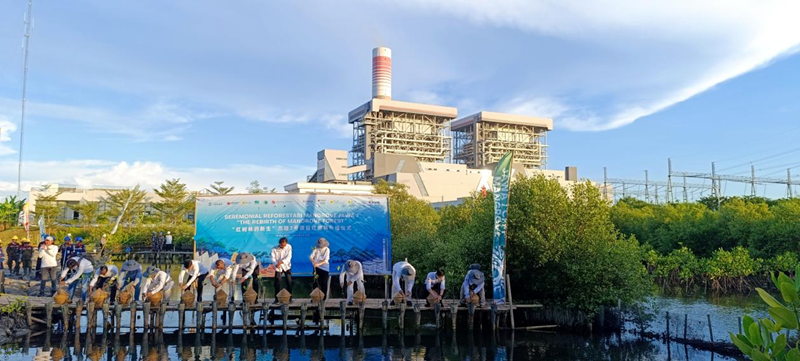 On May 18th, guests from China and Indonesia held a mangrove replanting ceremony at the Java 7 coal-fired power plant. Photo by journalist Cao Kai
Zhao Shibin, General Manager of State Energy Group Guodian Electric Power, said that the Java 7 coal-fired power plant located in Banten Province, Indonesia, has taken multiple measures such as adjusting the project plan, setting up mangrove seedling areas, and establishing maintenance teams to promote the restoration and expansion of the local mangrove area from 5 hectares to 19 hectares, and increasing the size of the mangrove forest to 150000 trees, building a dual defense line for ecology and development. He stated that protecting the ecology is not a multiple-choice question, and the National Energy Group will continue to fulfill its responsibilities for people’s livelihoods and strengthen the friendly bond of our common home.
Linda Krisnawati, Senior Environmental Education Expert at the Indonesian Ministry of Environment, stated that Indonesia has abundant mangrove resources, but due to climate change and human activities, some areas are experiencing severe ecological degradation. She called for strengthening cooperation with China, promoting the sharing of mangrove conservation technology, public education, community participation, and integrated development of ecological economy, and exploring new paths to achieve a win-win situation for both the environment and people’s livelihoods.
The attendees unanimously agreed that this dialogue and exchange provided a friendly platform for green development cooperation between China and Indonesia, and also contributed regional wisdom and practical examples to global marine ecological protection. The two countries will continue to deepen their green development partnership, jointly safeguard the mangrove forest as a “sea oasis”, and broaden the path of ecological cooperation.