
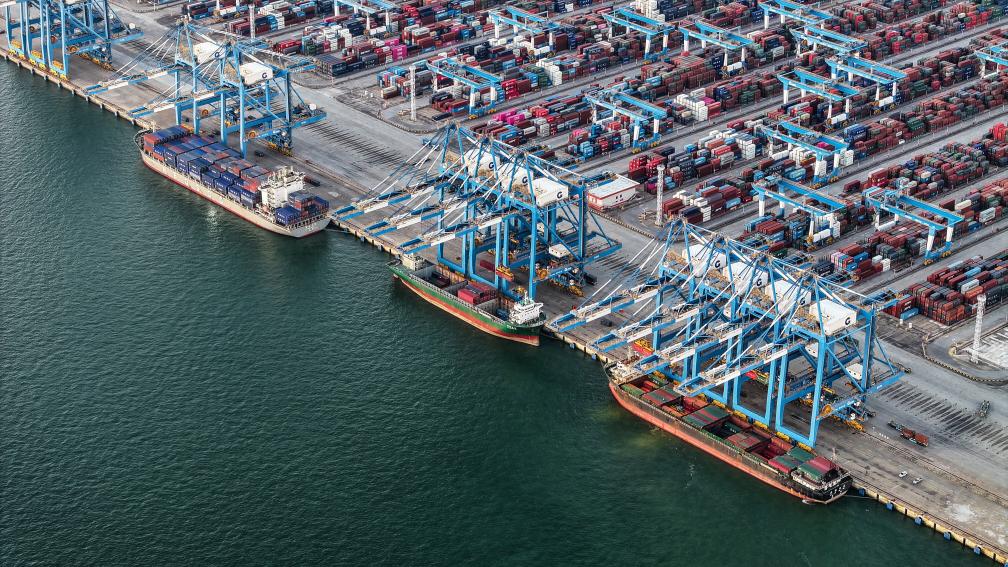
 On September 4th, a sea vessel docked at the container automation terminal of Qinzhou Port to load and unload containers (drone photo). Photo by Xinhua News Agency reporter Zhang Ailin
Recently, at the East Qinzhou Port Station in Guangxi, the X9596 West Land Sea New Channel Rail Sea Combined Transport Train, loaded with Cambodian rice, Thai perfume coconut and other ASEAN countries’ goods, left the East Qinzhou Port Station and headed for Chongqing Tuanjie Village Station. Since 2025, the West Land Sea New Channel Train has delivered more than 1 million TEUs of container goods – this is the first time that the annual delivery volume of the West Land Sea New Channel Train has exceeded one million TEUs since it was officially launched.
Now, relying on the new land and sea channel in the west, ASEAN commodities such as rubber from Vietnam and Indonesia, rice from Cambodia, perfume coconut from Thailand and so on are continuously sent to China; China’s new chemical materials, automotive parts and other products are also shipped overseas through rail sea intermodal transportation, covering dozens of categories such as electronic products, complete vehicles and components, machinery, and food.
For many years, the Western Land Sea New Corridor has witnessed the opening up of China’s western region to the outside world: China has maintained its position as the largest trading partner of ASEAN for 16 consecutive years, and ASEAN has become China’s largest trading partner for 5 consecutive years. According to data from the General Administration of Customs, in the first eight months of this year, ASEAN was China’s largest trading partner, with a total trade value of 4.93 trillion yuan between China and ASEAN.
Two years ago, some of the goods sent by Chongqing Wankai New Material Technology Co., Ltd. to ASEAN countries were redirected from the east to the sea via the Western Land Sea New Channel for rail sea intermodal transportation from Qinzhou Port. Compared with sailing from eastern ports, the transportation cycle through Qinzhou Port has been shortened by about ten days, and the customs clearance efficiency of goods has been high, which has been recognized by foreign customers. “Lin Zheng, the logistics manager of the company, said that from January to June this year, the company exported 93000 tons of goods through the Western Land Sea New Channel rail sea intermodal transportation, a year-on-year increase of 24%.
The economic, efficient, and convenient transportation advantages have won the favor of customers at home and abroad for the Western Land Sea New Channel trains. The company’s goods are exported through the Western Land Sea New Channel rail sea intermodal transportation, which has grown from a few hundred boxes in a year in 2019 to nearly 7000 boxes in half a year now, “said Xie Gongyin, Senior Logistics Manager of Huafeng Group Co., Ltd. The company’s goods rely on railway transportation to Qinzhou Port, which can save 10% of logistics costs. Moreover, railway transportation is less affected by weather and other factors, which can improve transportation efficiency and build an efficient transportation bridge for the company to cooperate with production enterprises in different regions, helping to explore new markets and form a broader industrial chain cooperation.
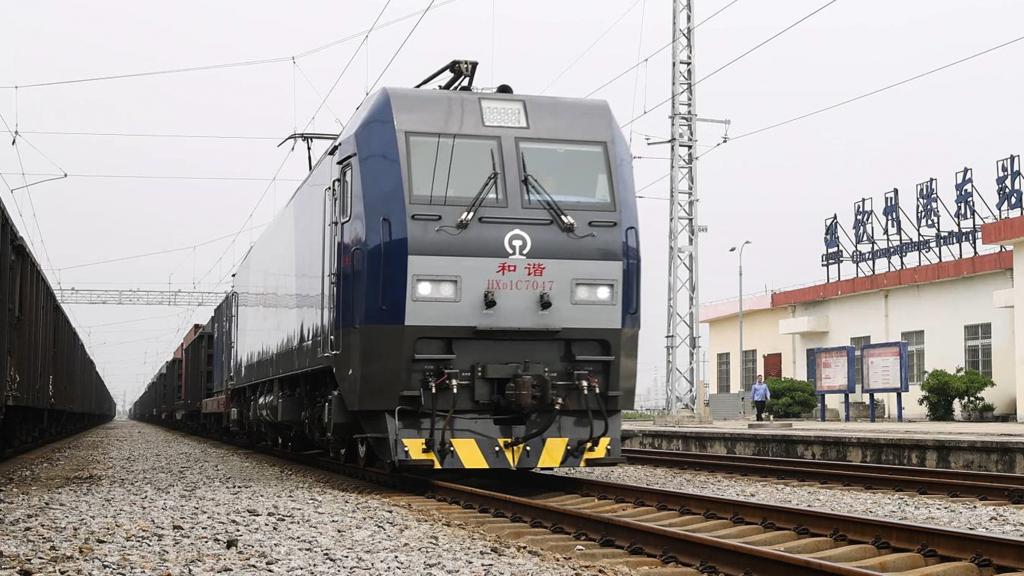 On September 4th, a train entered Qinzhou Port East Station to transfer containers. Photo by Xinhua News Agency reporter Zhang Ailin
As a hub station for the rail sea intermodal transportation of the Western Land Sea New Corridor, Qinzhou Port East Station in Guangxi is an important hub for the rail sea intermodal transportation of the Western Land Sea New Corridor. “Made in China” is going global here, and goods from around the world enter the Chinese market from here. Since the beginning of this year, the shipment from Qinzhou Port East Station has reached 10.572 million tons, a year-on-year increase of 29.7%. Among them, there has been a significant increase in the export of automobiles from Chongqing and Liuzhou to overseas via Qinzhou Port.
Zhao Jian, Deputy Station Chief of Qinzhou Port East Station of Guangxi Coastal Railway Company, introduced that in order to cope with the growth of cargo transportation, the station has coordinated the completion of platform equipment renovation in the port operation area, so as to have the conditions for unloading whole vehicles and provide safe, efficient, convenient and economical transportation services for domestic automobile exports to the Middle East, Southeast Asia and other markets. In the first quarter of this year, Qinzhou Port East Station has broken the daily loading record four times, with a maximum of 706 vehicles, and the daily loading and unloading operation record four times, with a maximum of 1375 vehicles.
In March of this year, a railway JSQ double decker transport vehicle special train loaded with 200 cars departed from Chongqing Yuzui Station via the Western Land Sea New Channel and directly arrived at Qinzhou Port in Guangxi. It was then shipped by roll on/roll off ship to Jebel Ali Port in Dubai, United Arab Emirates. This is the first time that the western region has sent goods to the Middle East through the Western Land Sea New Channel using “railway JSQ vehicles+sea freight roll on/roll off ships”, opening up a safer, more efficient, convenient and economical transportation solution for domestic automobile exports.
In order to improve the railway transportation capacity from the eastern and western lines of the Western Land Sea New Corridor to the mouth of the Beibu Gulf, China Railway Nanning Bureau organized nearly 7000 cadres and workers to carry out centralized construction of the Jiaoliu, Nankun, Xianggui, and Nanfang railways, improve the quality of the lines, and further smooth the important transportation channels connecting Southwest, Central South, and South China.
At the end of July, the first phase of station renovation construction was completed at Ma Huang Station in Qinbei District, Qinzhou City, which is an important “throat” for the entry and exit of railway sea intermodal trains in the western land sea new channel to Beibu Gulf Port. After the completion of the first phase of station renovation construction, Ma Huang Station will add 2 arrival departure lines and renovate 2 traction lines. It is expected that the entire station renovation project can be completed within this year, and the transportation capacity of the station will be increased by 25%, “said Li Cuilin, the station manager of Ma Huang Station of Guangxi Coastal Railway Company.
According to statistics from the railway department, this year there are a total of 24 scheduled operating lines for the Western Land Sea New Corridor, including 14 scheduled operating lines starting from Beibu Gulf Port and Zhanjiang Port, forming a convenient and efficient transportation network with Beibu Gulf Port as the main entry and exit point and Chongqing and Chengdu as the operation centers, covering major cities in the western region.
From the initial single “Beibu Gulf Port Chongqing” route to the current “Golden Logistics Network” that runs through the Beibu Gulf and western regions, the Western Land Sea New Corridor trains are becoming a new artery connecting China and ASEAN with an efficient and convenient transportation system.