
Touching the pulse of industrialization in Africa in Ethiopia
Reported by Liu Fangqiang, our reporter stationed in Addis Ababa
Unconsciously, the author has been stationed in Ethiopia for two years. Due to work reasons, I often deal with local media peers. Not long ago, Shewaye, the director of the documentary work department of the Ethiopian News Agency, called me. They are producing promotional videos for industrial parks in Ethiopia and hope that I can assist in translating and dubbing the Chinese version.
I have interviewed and reported on industrial parks in Ethiopia multiple times, witnessing their development; The production of a Chinese version of the promotional video is also aimed at attracting more Chinese companies to settle in. Despite my busy schedule, I gladly accepted the other party’s request.
Local employees can understand with just one gesture
The young labor force, abundant raw materials, and vast market… provide strong support for industrial development. “The commentary in the documentary is powerful and invites global investors to come to this ancient and vibrant land of East Africa.
As a major regional power, Ethiopia does have many unique advantages in terms of investment environment. Due to its location on the East African Plateau and abundant water resources, Ethiopia is known as the “water tower of East Africa” with abundant hydropower resources; As the second most populous country in Africa, Ethiopia has a total population of approximately 130 million, with 70% of the population under the age of 30. The young population has become a powerful driving force for economic growth and innovation.
However, due to the late start of industrialization, about 20 years ago, Ethiopia did not have the concept of industrial parks. I remember during an interview with former Prime Minister Haile Mariam of the country, he told me that after fully understanding the industrial cluster effect of industrial parks, he had proposed to China that he hoped to learn from China’s experience and accelerate the development of his own manufacturing industry.
If you want to attract more birds to come, you have to build bird nests, “recalled Haile Mariam. When he heard such a metaphor from Chinese leaders, he suddenly understood. This is what China calls’ building a nest to attract phoenixes’. Soon after, he led government officials and business representatives to study the construction and development experience of industrial parks in coastal areas of China.
The Oriental Industrial Park, located about 50 kilometers southeast of the capital Addis Ababa, is the first industrial park in Ethiopia, established with investment from Chinese private enterprises. After years of development, more than 100 enterprises have settled in the Oriental Industrial Park, covering industries such as building materials, steel, automotive assembly, metal processing, and textiles. It has made important contributions to Ethiopia’s product import substitution and increased foreign exchange income, and has also created about 23000 job opportunities for the local area. More importantly, from policies and regulations to factory construction and operation, the Oriental Industrial Park has paved an unprecedented new path for the country’s industrialization process and subsequent park construction.
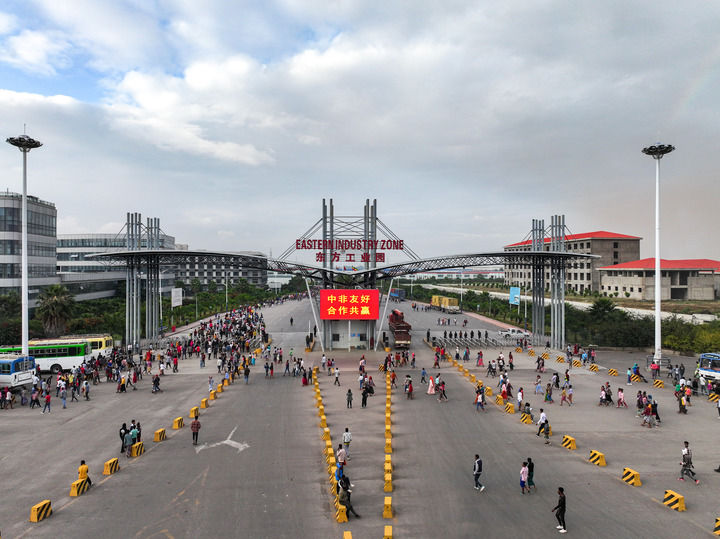 The entrance of the Oriental Industrial Park, photographed on November 3, 2023 in Dukem, Ethiopia (photo provided by the interviewee)
Getu Kebebei, the manager of Dongfang Textile Printing and Dyeing Co., Ltd. located in Dongfang Industrial Park, is familiar with the reporter. He is one of the witnesses to the rapid development of the park. Over the course of six years, he gradually rose from a grassroots worker to a management position. Kebei is 35 years old this year. After graduation, he joined this factory and started as an operator of a molding machine. Later, he continuously received training in new technologies and is now able to diagnose and repair factory machines. Later, due to his outstanding performance, he was promoted to the management team and managed about 200 workers.
The company manager Li Jianrong told me that at the beginning, there were about 80 Chinese workers in the factory, but now only half are left, mainly because local employees have been trained and there is no need for so many Chinese people. Now when communicating with local senior employees, he understands with just a glance and a gesture. When he first came, he taught them with his own hands, taking it seriously
In addition, Chinese factories such as Oriental Textile Printing and Dyeing have also driven many local agents in Ethiopia. After some local enterprises make money, they go to China to learn and purchase, get to know more Chinese enterprises, and then partner to invest and open factories in Ethiopia.
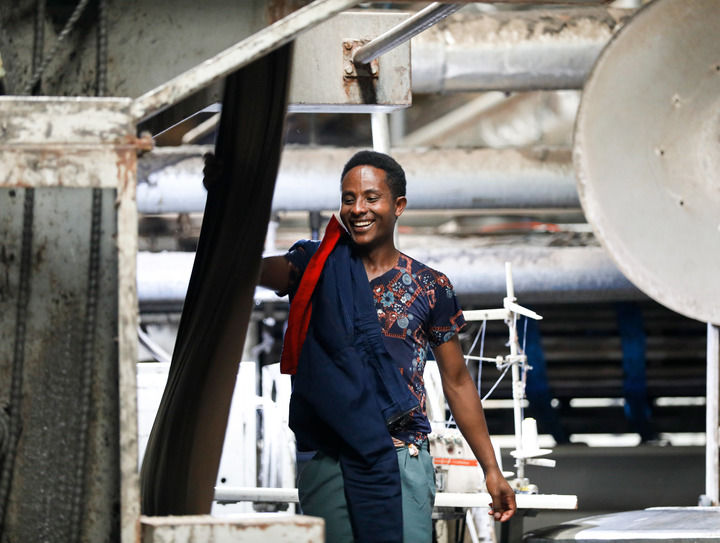 On February 16, 2024, workers worked in the workshop of Oriental Textile Printing and Dyeing Co., Ltd. in the Oriental Industrial Park in Dukem, Ethiopia. (Image provided by interviewee)
Point by point, surface by surface. At present, Ethiopia has built 24 comprehensive industrial parks, all of which have a complete set of production, operation, and commercial services, covering the pharmaceutical industry, textile and clothing industry, and information technology industry. These industrial parks are playing an increasingly important role in driving export growth, creating employment, and promoting import substitution.
There is a feeling of returning to China on the highway
Developing industry in Africa has relatively low labor costs, but due to a significant investment gap in infrastructure, logistics costs are much higher than the world average. In recent years, Ethiopia has increased internal connectivity and promoted commercial development by vigorously developing transportation infrastructure. During this process, a large number of Chinese companies came to Ethiopia to help build the first expressway, the first urban light rail, and the first cross-border electrified railway.
The road from Addis Ababa to Adama has always been a major artery for logistics transportation in Ethiopia, with a large number of vehicles traveling back and forth between the ports of Ethiopia and Djibouti every day. However, the road between the two places is always crowded and inefficient, which once became a bottleneck for Ethiopia’s foreign trade logistics.
In May 2014, the Addis Ababa Adama Expressway constructed by China Communications Construction Corporation was completed, which improved the problem of traffic congestion. I have walked on both the old and new lines of this highway, and the comparison is obvious. The old road is similar to a provincial road in China, but due to the constant traffic of heavy trucks, the ground is bumpy and dusty. The highways are basically no different from those in China, with toll booths, guardrails, service areas, and some Chinese enterprise billboards on the roadside. Every time I drive on this highway, I feel like I’m back in China.
As the most populous landlocked country in the world, Ethiopia’s main seaport is the neighboring port of Djibouti, where over 95% of its foreign trade products need to be transshipped annually. On January 1, 2018, the Addis Ababa Djibouti Railway, constructed by Chinese enterprises, officially opened for commercial operation. With a transportation mileage of 752 kilometers, road transportation takes 3 to 7 days. After the opening of the Addis Ababa Djibouti Railway, freight transportation only takes 20 hours, and the transportation cost is only two-thirds of road transportation.
Similar development visions are also accelerating their implementation in other African countries. In November 2025, the Tanzania Zambia Railway activation project will enter the comprehensive construction phase. With the advancement of the activation project, the freight capacity of the Tanzania Zambia Railway is expected to increase to 2.4 million tons per year, and the transportation time of goods may be shortened by nearly two-thirds. This railway, known as the ‘Road to Freedom’, will become an important engine for promoting regional trade, developing manufacturing, and expanding employment.
Employers are very satisfied with the graduates of Luban Workshop
Africa is the continent with the youngest population in the world. According to data released by the African Union (AU) and the African Development Bank, the total number of Africans aged 15 to 35 exceeds 400 million, and is expected to exceed 830 million by 2050. Young people are a valuable asset for promoting industrialization and sustainable development in Africa. In recent years, China has continuously empowered young people in Africa through vocational and technical education and training cooperation, helping Africa transform its demographic dividend into strong productivity. Chinese vocational education brands represented by Luban Workshop have taken root in many African countries, and a market-oriented and industry education integration model is gradually taking shape.
In the Luban Workshop training room in Addis Ababa, an industrial robot arm is grabbing physical objects and simulating assembly line production. With the help of a mechatronics control platform from China, teachers are explaining to students the operation and running of automation equipment.
This Luban Workshop, built with assistance from China, was unveiled and put into operation in 2021. It has four training directions: industrial sensors, mechatronics, industrial control, and industrial robots. It has been designated by the African Union as a high-quality skilled talent training center for all of Africa.
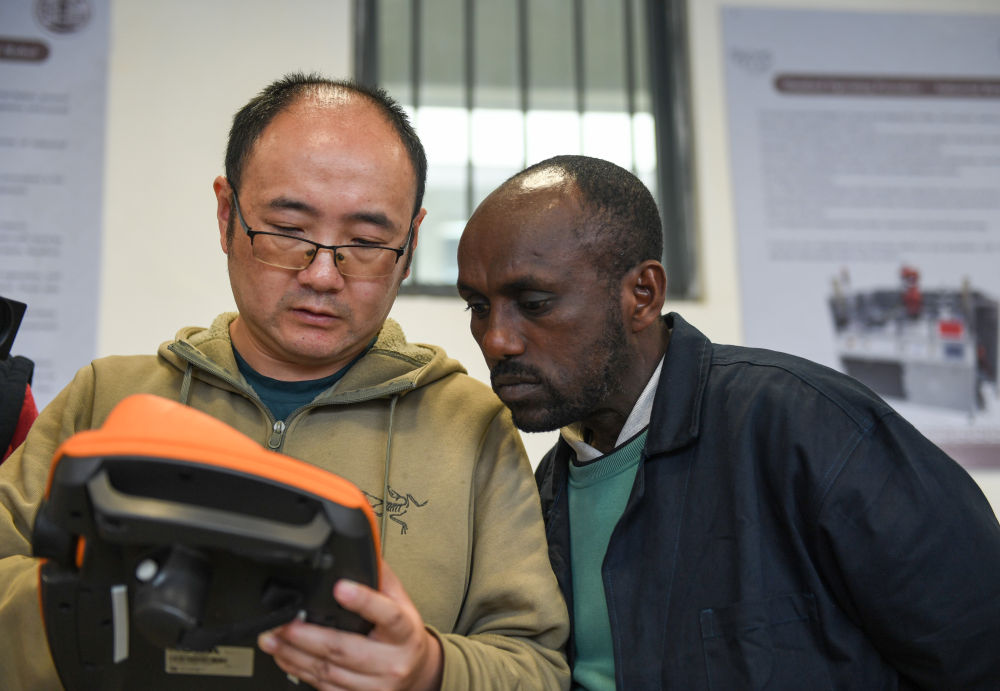 On February 15, 2024, at the Ethiopian Federal Vocational and Technical Training Institute in Addis Ababa, Jiang Jiang (left), the Chinese leader of the Luban Workshop, exchanged teaching content with local teacher Jonas Akale (Chinese name Ai Youhan). (Photo by Li Yahui)
On the photo wall at the entrance of the training room, there are plenty of work photos of graduates from Luban Workshop hanging. These photos were voluntarily sent by various employers and companies, and they are very satisfied with the graduates, “Pan Liang, the Chinese coordinator of Luban Workshop, told me.
To my surprise, Hernoke, a local college student I interviewed, won the best place among African competitors in the second “the Belt and Road” International Skills Competition held in Chongqing in 2024. Until now, Henoch still maintains contact with me, occasionally showing me his latest research results and consulting on China’s progress in these fields.
Since the unveiling of the first Luban workshop in Africa in Djibouti in 2019, 17 Luban workshops have been established and produced in 15 African countries, from Kenya and Tanzania in the east to Nigeria in the west, from Djibouti and Ethiopia in the northeast to Egypt across Asia and Africa, becoming a shining business card for China’s international cooperation in vocational education. I learned in the interview that graduates from the workshop are widely popular, and local, Chinese, and multinational companies are all looking for the talents they need at Luban Workshop.
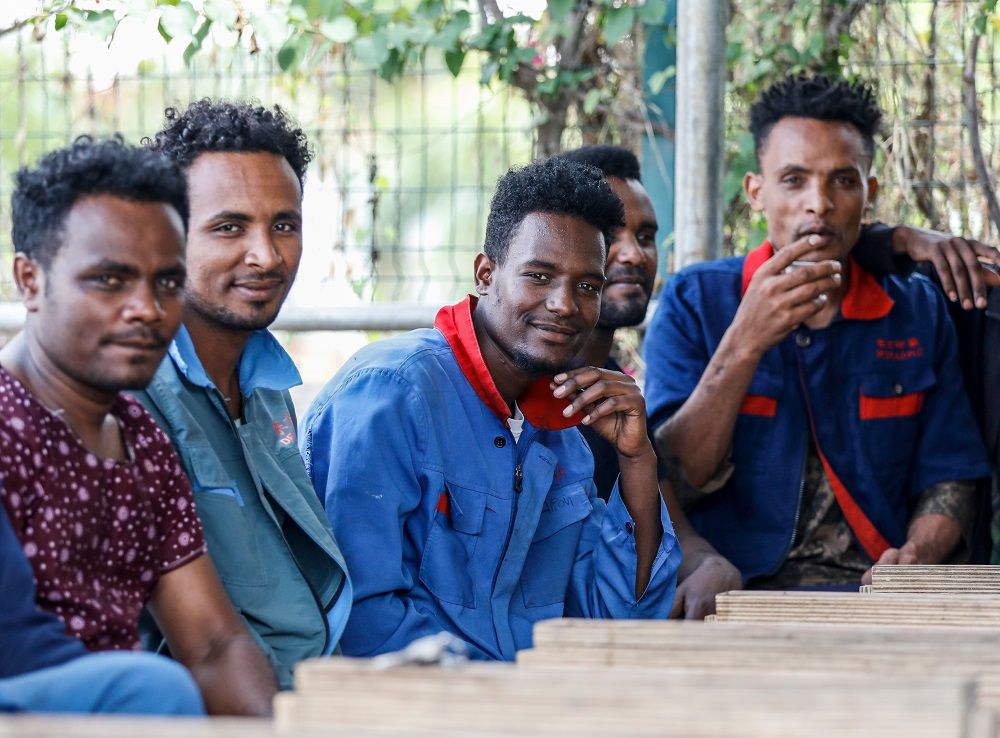 At the Oriental Industrial Park in Dukem, Ethiopia, workers take breaks during work breaks. (Photo by Li Yahui)
Africa’s industrialization needs to have its own pace
In history, developed Western countries completed the Industrial Revolution in over 200 years, while China took over 70 years to basically follow the industrialization path taken by developed Western countries, known as a rare development miracle in human history. The population of the African continent is comparable to that of China. I often wonder how many years it will take for Africa to complete its industrialization process?
It cannot be denied that in recent years, many African countries have made significant progress in industrialization and improved their economic and social development. However, as I strolled through the streets of Addis Ababa, it took me half a day to search for two No. 5 batteries; Whenever I return to my home country for vacation, my friends ask me to help bring back various daily necessities; Watching old cars emitting black smoke on the road, I also realize the reality that this is Africa, where living materials are not yet abundant, and the industrialization process is still a long way to go.
For a long time, the African continent has been marginalized by the international community, with resources being heavily exploited and becoming a “warehouse” for the world’s raw materials. Despite the continuous efforts of African countries to extend their industrial chains and increase product added value, most of them currently lack a complete industrial system, and even the most basic industrial components still need to be imported.
The unstable political situation, single economic structure, prominent infrastructure shortcomings, weak internal trade, and excessive dependence on external markets and systems have seriously constrained the industrialization process of the African continent.
Since 2000, the African Growth and Opportunity Act has been at the core of US economic policy towards Africa, allowing eligible sub Saharan African countries to export over 1800 products to the US without tariffs. In 2020, civil war broke out in northern Ethiopia, and in 2022, the United States suspended Ethiopia’s preferential policies under the law on the grounds of human rights violations by the Ethiopian government. In 2025, the United States will impose a 10% tariff on Ethiopia, further weakening the country’s competitiveness in exporting goods, especially in the textile and clothing industry.
During the interview and research process, many African experts expressed that in the process of promoting diversified cooperation partners, Africa can consider further shifting its focus to Asia, especially China. China has maintained its position as Africa’s largest trading partner for 16 consecutive years. In addition, China has announced the implementation of zero tariffs on 100% tariff items for 53 African countries that have established diplomatic relations with China.
Equally noteworthy is that development cannot be achieved without a stable and secure environment. In recent years, civil wars and coups have occurred one after another in many African countries, seriously hindering the industrialization process. Tigray and Amhara states in northern Ethiopia were once industrial hubs with a strong economic foundation. However, from 2020 to 2022, conflicts continued in the region, and wars destroyed years of industrial development, causing most factories to be paralyzed and production to not be fully restored to this day.
Since 2025, there have been consecutive coups in Madagascar and Guinea Bissau; In the Great Lakes region, known as the “heart of Africa,” fighting resumed in eastern Congo in December. The conflict between the government army and the M23 movement escalated, forcing over 500000 people to flee their homes; The armed conflict that has lasted for over two years in Sudan has resulted in a large number of civilian deaths, and over 30 million people urgently need humanitarian assistance.
Although the direct causes of instability in various countries are not the same, there are generally governance challenges intertwined behind it, such as colonial legacy issues, the spread of terrorism, and lagging economic development. The political situation is unstable, and businessmen are concerned about policy changes, financial and personal safety. In this environment, companies are naturally unwilling to invest, workers cannot find employment, and the productivity and creativity of the entire society will be stifled.
In this context, the industrialization process in Africa is destined to not be achieved overnight, and its advancement requires countries to form a joint force in key areas such as infrastructure, policy systems, regional cooperation, and business environment. Taking the Oriental Industrial Park as an example, the park has solved the problem of power supply with the support of Chinese technology, successfully attracting manufacturing enterprises such as ceramics and textiles to settle in, and becoming a demonstration benchmark for regional industrialization. Africa as a whole still faces a significant electricity gap, but this challenge can be transformed into investment opportunities, especially in the field of renewable energy, such as solar and wind energy development, which can become a new driving force for industrialization.
In addition to improving hardware facilities, optimizing the business environment is also a key factor determining the prospects of industrialization in Africa. The “software” factors such as policy stability, legal transparency, and reasonable taxation directly affect the retention of enterprises. Only by establishing predictable policy frameworks and efficient service systems can we attract and retain enterprises, and promote Africa’s industrialization towards a sustainable development stage.
It can be said that the path of industrialization in Africa is a multiple race against time, resources, and institutions. The African people need to address fundamental issues such as political environment, infrastructure, global division of labor, and education. If these bottlenecks cannot be overcome, the industrialization process may be indefinitely prolonged. It is full of hope that in each interview, I have also deeply felt the vitality of Africa’s young population and the potential of the market, which is the greatest confidence of industrialization.
When the dividend of the young population gradually transforms into a reserve of skilled workers, when regional cooperation eliminates trade barriers, and when a stable business environment attracts global capital to settle in… People may not witness another industrial development miracle soon, but I believe that this continent will eventually find its own pace of industrialization.
Published in the 10th edition of “Reference News” on January 1, 2026
Editor Zhang Jiaqing