
At the beginning of 2026, the Balkan region will experience a once-in-a-year heavy snowfall. I took a vehicle back to the capital Belgrade from the southern mountains of Serbia, passing through a tunnel that crosses the mountains. After a moment, my view suddenly became clear, and the road ahead was flat and snow free. As the journey approached the city center, a viaduct slowly approached with the red words “China Aid” written on it – this E763 highway, locally known as “A2”, was the first highway project built by China in Serbia.
In Serbia, roads connect various cities, towns, and villages within its borders, crisscrossing and arranged in an orderly manner. Every time I take a bus through the city and town, I not only marvel at the convenience brought by highways and bridges, but also wonder how the spirit of Chinese enterprises’ “opening the way to mountains and building bridges by water” is reflected thousands of miles away? What changes have these projects brought to the local area?
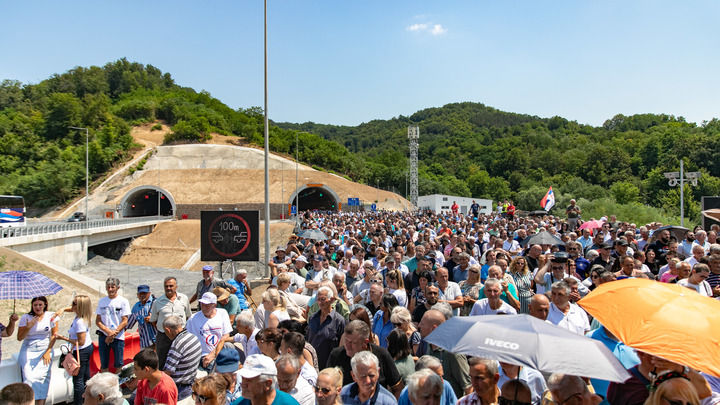 On July 5, 2025, local residents attended the opening ceremony in the southwestern Serbian city of Luchany. Xinhua News Agency (photo by Wang Wei)
Ten years of road construction and one day of opening to traffic
The E763 highway connects the capital of Serbia to the port of Bar in Montenegro, with a total length of approximately 258 kilometers within Serbia. In 2014, the construction of road sections by Chinese enterprises began, and most of the sections have been completed. Over the past 12 years, Shandong Expressway and China Communications Construction Corporation have successively carried out the construction of E763. During this period, they have experienced natural disasters such as floods and landslides, encountered complex geological conditions, and encountered difficulties in starting construction of bridges and railway crossings. Through multiple communications, attempts, proofs, and experience absorption from all parties, the builders of China and Serbia have gone from face-to-face to shoulder to shoulder.
Serbian engineer Predrag has been working at Shandong Expressway for nearly 9 years. Before the project started, he had already participated in the drawing design and later changed from “Party A to Party B”, becoming a Serbian engineer for a Chinese enterprise. He witnessed the road from blueprint to reality with his own eyes, and deeply felt the difficulties of project construction. The most memorable one was a railway that was suspended for bridge repair.
He recalled that there was a railway in Serbia connecting the Kolubara mine and the largest thermal power plant in Serbia, the Nikola Tesla power plant, and the construction of E763 required a bridge to be built on the railway. Because it involves important energy, it is a 24-hour non-stop railway, “said Praedrag. He and his Chinese colleagues have communicated several times with government departments, as well as responsible parties for signals, tunnels, mines, power plants, etc., and finally reached a plan to shut down for 4 hours a day.
Chinese engineers Liu Rucheng and Lu Yunfeng from Shandong Expressway were once “brothers” who fought side by side. They entered the project in 2013 and 2014 respectively, in charge of engineering and contracts. Liu Rucheng introduced that the floods in 2014 brought additional construction costs to the project, for which the Chinese side proposed a plan of “stone throwing and replacement, geotextile reinforcement, and subsoil drying”. Lu Yunfeng said that in the face of Serbia’s doubts about technology and cost, “Chinese enterprises self funded a test section for technical verification and cost analysis. Serbia immediately ‘made a decision’ and agreed to sign after seeing the verification results
E763 not only witnessed the true implementation of China’s experience from plan to practice, but also witnessed the courage of Chinese engineers to shoulder heavy responsibilities, overcome difficulties, and strictly control quality under uncontrollable geological conditions.
Shou Jicheng is an engineer from China Communications Construction Corporation. After graduating in 2010, he first participated in the construction of highways, bridges, and ports in Equatorial Guinea. In 2017, he came to Serbia and participated in the construction of the Hungary Serbia Railway and E763. When talking about his past experiences, he said, ‘The hardest part is still building tunnels.’.
Due to the complex geological structure at the exit of the tunnel, only about 150 meters were completed in a year, “said Shou Jicheng. During the construction, he faced the risks of tight schedule, cost overruns, and tunnel collapse. Having never experienced such a complex project before, he withstood the pressure and ultimately completed it on time. He said, “Even though the schedule pressure and geological structure are unpredictable, quality is the ‘steel standard’ for Chinese enterprises to build infrastructure overseas.
Chinese engineering highlights the Chinese business card
Looking back at the 15 years since Chinese enterprises entered Serbia, they cannot do without the infrastructure project “Zemun Bridge” that was first built in Serbia. This iconic project, which started construction in 2011 and was completed in 2014, is not only Serbia’s first bridge built on the Danube River in nearly 70 years, but also a benchmark for infrastructure cooperation between China and Serbia.
Zhao Pan, an engineer from China Communications Construction Corporation, became involved with Serbia for the construction of the Zemun Bridge. He has participated in the construction of major domestic bridge facilities such as Hangzhou Bay Cross Sea Bridge and Fujian Pingtan Cross Sea Bridge. During his 15 years in Serbia, he has been involved in the construction of Zemeng Bridge and E763.
In 2011, the construction of Zemun Bridge began. The technology of bridge construction in China has already matured domestically, but at that time it was advanced experience for Serbs. “He said that initially some Serbian engineers still had prejudices, but as the project implementation gradually deepened, their mentality changed from dissatisfaction to admiration. Later, this engineer invited me to participate in his master’s thesis defense at the University of Belgrade, and the topic of the thesis was the Zemun Bridge jointly built by China and Serbia, “he said with a smile.
The Zemun Bridge, as a cross Danube bridge connecting the tourist destination of Zemun town and Borca, has witnessed the rise of a “satellite city” of Belgrade over the past decade.
When the car drove into Borca, the size of the town was somewhat unexpected to me. In this town, which is about a 20 minute drive from the city center, new residential buildings are being constructed vigorously. Zhao Pan told me that 15 years ago, this place was still a farmland and village without buildings or commercial districts.
Witness the ‘Hardcore Friendship’
There is a saying in China that goes, ‘If you want to become rich, first build roads.’ These large-scale infrastructure projects spanning over a decade are gradually solving the ‘starting problem’ of Serbia’s development, promoting significant economic growth and bringing tangible benefits to the local people.
For this purpose, I visited two towns located along the E763 route: Ubud and Obrenovac.
Ubud is about a 40 minute drive from the center of Belgrade and is the largest town outside the capital closest to the city center. Predrag told me that in the past 10 years, Ubud has built stadiums, hotels, supermarkets, and residential areas, becoming a hot spot for daily commuting Belgrade office workers to buy houses.
Another town along the route, Obrenovac, benefited from the construction of the E763 highway and became an industrial hub. The Nikola Tesla thermal power plant in its jurisdiction accounts for over 30% of Serbia’s total electricity generation. Zhao Pan said that in addition to building highways, Chinese enterprises have also built a bridge across the Sava River, solving the problem of the only bridge in the town that could not accommodate trucks. Walking into Obrenovac, the carefully constructed detached houses, wide city streets, renovated church walls, and white steam emitting chimneys of the thermal power plant all tell the story of the thriving place.
Through such visits, roads, bridges, and tunnels have given me a genuine sense of reality. Through repeated questioning and observation, I have come to better understand the true meaning of the “iron core friendship” between China and Serbia. (Zhang Xuan)